


Views: 0 Author: Site Editor Publish Time: 2026-09-18 Origin: Site


Rare earth elements power modern high-tech manufacturing, driving everything from smartphones to electric vehicle motors. However, in their refined oxide state, they react aggressively to standard atmospheric conditions. Exposure to ambient moisture and carbon dioxide rapidly degrades the stoichiometry of these materials. Global supply chain volatility forces manufacturers to stockpile materials for longer durations, making the risk of degradation higher than ever. Failure to implement rigorous storage protocols results in hydration, carbonate formation, and particle agglomeration. This forces operators to execute energy-intensive pre-heating calcination processes or risk catastrophic defects in the final product. Safeguarding yield and maintaining the integrity of industrial rare earth oxide materials requires a systematic approach to environmental control, specialized packaging, and strict handling protocols. Proper isolation bridges the gap between chemical separation and final metallization.
Moisture is the primary threat: Uncontrolled humidity leads to hydroxide and carbonate formation, fundamentally altering the mass and reactivity of the oxide.
Nano-scale powders require extreme isolation: Due to their massive surface area, nano rare earth oxide powder demands vacuum sealing or inert gas environments to prevent irreversible agglomeration.
Preventative storage mitigates supply chain risks: Investing in desiccator cabinets and argon-purged environments for long-term stockpiling protects against global sourcing shortages and reduces the bottleneck of pre-production calcination.
Verification is non-negotiable: Even with optimal storage, analytical verification (like Thermogravimetric Analysis) is required to confirm material purity before introducing it to the production line.
Storage solutions must prevent specific baseline degradation mechanisms to maintain material viability for high-tech applications. When a refined Rare Earth Oxide leaves the separation facility, it is highly reactive. The success criteria for any storage protocol depend entirely on its ability to halt atmospheric interaction. If the environment is not strictly controlled, the physical and chemical properties of the powder shift. This renders standard manufacturing recipes inaccurate and compromises the final product's performance on the production floor.
Many rare earth compounds act as powerful desiccants. Lanthanum, Neodymium, and Cerium oxides rapidly absorb atmospheric water vapor to form hydroxides. This hydration process occurs quickly even in moderately humid environments. Lanthanum oxide is particularly notorious; it absorbs moisture so aggressively that the resulting chemical conversion to Lanthanum hydroxide involves a physical volume expansion. If stored in a tightly sealed but moisture-permeable container, this expansion can actually breach the packaging.
This creates a severe problem for high purity rare earth oxide. Manufacturing processes rely on precise stoichiometric calculations based on the assumption of a pure, dry oxide. If a batch has absorbed 5% of its weight in water, a technician weighing out 100 kilograms is actually introducing only 95 kilograms of the active oxide into the synthesis reactor. This mass discrepancy leads to improper alloy ratios. In permanent magnet manufacturing, a Neodymium-poor alloy directly causes structural weaknesses and severe magnetic deficiencies in the final metal.
Ambient carbon dioxide presents a secondary, often more stubborn threat. Exposed oxides react with CO2 to form surface carbonates. This chemical reaction creates a passivation layer over the powder particles. Unlike simple moisture absorption, carbonate formation fundamentally alters the surface chemistry of the material and requires significantly more energy to reverse.
The impact on downstream high-tech applications is severe. Surface passivation degrades the magnetic coercivity required for high-performance permanent magnets used in hard disks and electric vehicle motors. In catalytic applications, such as those utilized in advanced electronics and emissions control, the carbonate layer blocks active sites. This drastically reduces the material's catalytic efficiency. Removing these carbonates requires thermal energy exceeding 800°C, adding massive overhead to the production cycle.
Physical degradation is just as problematic as chemical alteration. nano rare earth oxide powder possesses a massive surface-area-to-volume ratio, making it incredibly susceptible to environmental forces. When exposed to even trace amounts of humidity, capillary condensation occurs between the individual nanoparticles. Liquid bridges form at the contact points between particles.
Combined with strong Van der Waals forces, this condensation causes the fine powder to clump into hard agglomerates. Once agglomerated, the powder loses its primary advantage: its uniform dispersion capability. In advanced manufacturing processes like ceramic doping or precision polishing, these clumps cause uneven distribution. This leads to mechanical stress points or optical defects in the final component. Reversing this agglomeration is often impossible without aggressive mechanical milling, which introduces unwanted contamination from the milling media.
Storage protocols must be adapted based on the duration the material will remain dormant. Strategic stockpiling involves holding bulk materials for months or years to buffer against global supply chain volatility. These facilities require passive, highly robust isolation systems that do not rely on constant human intervention. Active production storage refers to short-term staging areas where materials are held immediately prior to transformation into metals. Active storage environments experience frequent access, requiring dynamic environmental controls that quickly recover target conditions after doors or containers are opened.
To establish a proper active production dry room, facilities must follow a strict sequence of environmental controls:
Install a dedicated desiccant wheel HVAC system utilizing lithium chloride or silica gel to continuously strip moisture from the incoming air.
Maintain a positive pressure environment of at least 0.05 inches of water column to prevent ambient factory air from infiltrating through microscopic leaks.
Construct interlocking airlocks at all personnel and material entry points to ensure the main chamber is never directly exposed to the factory floor.
Deploy continuous dew point monitors calibrated to trigger automated alarms if the internal atmosphere deviates from the baseline parameters.
Strict humidity control is the foundation of oxide preservation. For most industrial applications, the ambient Relative Humidity (RH) must be maintained below 10%. Highly reactive compounds, such as Lanthanum oxide, often require environments with less than 1% RH or a controlled dew point of -40°C.
Temperature stability is equally critical. Climate-controlled facilities are necessary not just for ambient comfort, but to prevent temperature fluctuations that cause condensation. If a sealed container experiences a rapid drop in temperature, any trapped ambient air will reach its dew point. This deposits liquid water directly onto the powder inside the packaging. Maintaining a steady temperature eliminates this internal condensation risk.
Photo-sensitivity affects specific rare earth compounds, particularly certain doped oxides used in phosphors and optical applications. Prolonged exposure to ultraviolet light can induce subtle changes in the oxidation state of surface atoms, slightly altering the material's luminescent properties.
To mitigate this risk, storage protocols should mandate opaque containers. If transparent packaging is necessary for visual inspection, the storage environment must utilize UV-filtered lighting or be kept entirely dark when not actively accessed by personnel. High-density polyethylene drums naturally provide excellent light blocking capabilities for bulk storage.
Long-term storage of bulk powders introduces mechanical risks. Constant low-frequency vibration from nearby heavy machinery or transport corridors causes powder compaction. Over time, the material settles into a dense, solid block that is difficult to extract and process without aggressive mechanical breaking.
Vibration also causes stratification in mixed rare earth feeds before they undergo final separation. Larger particles rise to the top while finer particles sift to the bottom, destroying the homogeneity of the batch. Storage facilities must isolate bulk silos and racking systems from structural vibrations. Silos should be equipped with fluidization pads that inject dry nitrogen to keep the powder aerated and flowing freely during discharge.
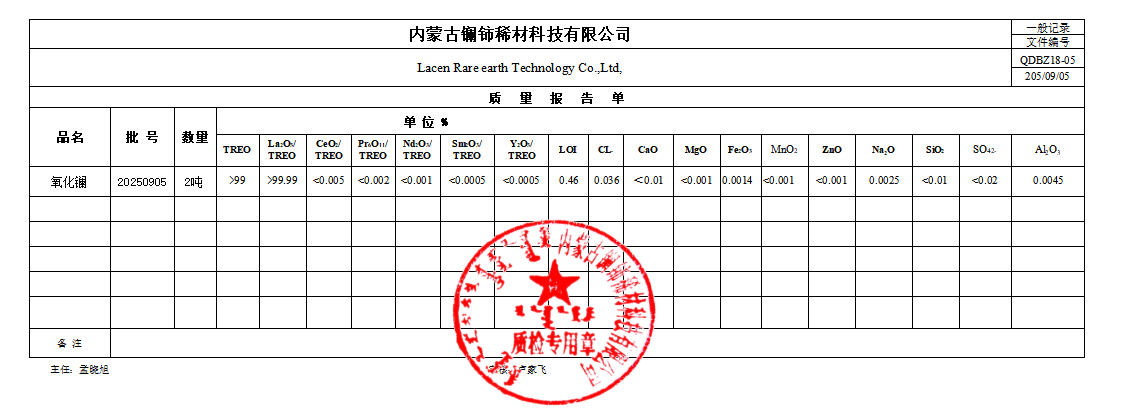
Selecting the correct containment technology requires balancing material sensitivity, production scale, and the intended duration of storage. The goal is to match the packaging architecture to the specific vulnerability of the oxide. Operators must evaluate the barrier properties of the packaging against the operational realities of the production floor.
Storage Method | Best Suited For | Primary Advantages | Operational Limitations |
|---|---|---|---|
Double-Vacuum Aluminized Mylar | High purity oxides, Nano powders | Complete moisture and gas barrier; zero internal condensation risk. | Labor-intensive packaging process; bags are strictly single-use. |
Argon Purged HDPE Drums | Bulk industrial stockpiling | Argon blankets the powder; highly scalable for multi-ton storage. | Requires specialized purging equipment and continuous gas supply. |
Dynamic Auto-Desiccator Cabinets | Active production staging | Rapid humidity recovery after frequent access by personnel. | High energy consumption; limited internal volume capacity. |
Fluoropolymer (PTFE) Bottles | Laboratory and analytical standards | Zero chemical leaching; highly inert over decades of storage. | Cost-prohibitive for large-scale industrial volumes. |
Displacing oxygen and moisture is the primary defense mechanism. Inert gas purging involves backfilling containers with Nitrogen or Argon. Argon is generally preferred for highly sensitive materials because it is heavier than air. It settles over the powder, creating a dense protective blanket that prevents ambient air from reaching the material even if the container seal is slightly compromised during handling.
For maximum protection, double-vacuum-sealed aluminized Mylar bags are utilized. This method removes the atmosphere entirely, eliminating the risk of internal condensation. The aluminized layer provides an absolute barrier against moisture vapor transmission. This makes it the standard for preserving high-value nano powders during global transit and long-term warehouse storage.
Materials frequently accessed during the metallization process require specialized staging environments. Static desiccators rely on silica gel or molecular sieves to absorb ambient moisture. While effective for undisturbed storage, they recover slowly when opened, exposing the powder to humidity spikes.
Dynamic auto-desiccator cabinets are required for active production lines. These units constantly monitor internal humidity and automatically purge dry nitrogen through the chamber whenever the RH rises above a set threshold. For larger operations, entire dry rooms are constructed, allowing personnel to handle bulk materials without exposing them to ambient factory air. These rooms utilize massive desiccant wheels to maintain ultra-low humidity environments regardless of external weather conditions.
The container itself can become a source of contamination over extended stockpiling periods. Standard borosilicate glass is often avoided for long-term storage of highly reactive oxides due to leaching risks. Over several years, trace alkali metals like sodium can migrate from the glass matrix into the powder, contaminating high-purity batches and ruining their electrical properties.
High-density polyethylene (HDPE) containers provide an excellent balance of moisture resistance, durability, and chemical inertness for bulk storage. For ultra-high-purity applications, fluoropolymer containers made of PTFE or PFA are preferred. These materials are completely inert, ensuring zero trace contamination even after decades of storage in harsh industrial environments.
Many facilities rely on pre-production remediation to fix storage failures. The most common practice is preheating, or calcination, of the oxides immediately before synthesis. By heating the powder to temperatures between 800°C and 1000°C in a rotary kiln, manufacturers can drive off absorbed moisture and decompose surface carbonates, returning the material to its pure state.
Calcination carries heavy operational burdens. The energy required to heat multi-ton batches to 1000°C is immense, driving up utility bills. It also accelerates wear on industrial furnace refractories and introduces a massive time delay into the production schedule. Investing in inert storage infrastructure eliminates the need for routine calcination. The upfront capital expenditure for climate control is rapidly offset by continuous energy savings and increased production throughput.
Introducing degraded oxides into high-value applications carries severe financial consequences. If hydrated Neodymium oxide is used to synthesize NdFeB permanent magnets, the excess oxygen creates internal defects. This drastically lowers the magnetic remanence and coercivity. Entire batches of high-value magnets may fail quality control and require scrapping, wasting not just the rare earth material, but the labor and energy used to process it.
During periods of global sourcing shortages, replacing ruined materials causes operational paralysis. The financial impact is not just the cost of the raw material, but the cost of halted production lines and missed delivery contracts. Preventative storage acts as a physical insurance policy against these catastrophic yield losses.
Adapting storage protocols from gram-scale R&D environments to multi-ton industrial facilities presents distinct engineering challenges. In a laboratory, keeping a few hundred grams of powder in a controlled glovebox is straightforward. On the production floor, managing bastnäsite concentrates and refined oxides requires massive infrastructure.
Maintaining inert atmospheres in large-scale hoppers requires continuous gas monitoring and automated purging systems. Industrial silos must be designed with mass-flow geometries, typically utilizing 60-degree cone angles, to prevent powder compaction. They must be equipped with pneumatic vibrators that operate only during discharge to minimize settling during long-term storage.
Storage protocols frequently fail during the brief window when material is transferred to the production floor. Bridging the gap between separation and metallization requires ensuring oxide integrity right up to the point of transformation. When a cold, sealed container is opened in a humid factory, flash-hydration occurs instantly. The cold powder acts as a condensation surface, pulling moisture out of the air and ruining months of careful storage in seconds.
Facilities must implement strict handling protocols to prevent this. Containers should only be opened inside environmentally controlled glove boxes. For bulk transfers, closed-loop pneumatic transfer systems should be used. These systems use dry nitrogen to blow the powder directly from the storage silo into the synthesis reactor. Dense phase pneumatic conveying is preferred over dilute phase to minimize particle attrition and ensure the material never touches ambient air.
Assumption is the enemy of quality control. Even with optimal storage infrastructure, analytical verification is required to confirm material purity before introducing it to the production line. Thermogravimetric Analysis (TGA) is the standard method for this verification. X-ray Diffraction (XRD) can also be utilized to detect the crystalline presence of hydroxides or carbonates.
A standard TGA verification protocol involves the following steps:
Extract a representative sample from the storage container using a sealed sampling thief to prevent ambient exposure during transit to the lab.
Establish a baseline mass measurement using a high-precision analytical balance inside a dry nitrogen glovebox.
Execute a ramp heating profile, typically raising the temperature from ambient to 1000°C at a rate of 10°C per minute.
Analyze the mass loss curve: moisture typically evaporates between 100°C and 200°C, hydroxides decompose around 400°C, and carbonates break down above 750°C.
Calculate the total Loss on Ignition (LOI) and compare it against the strict acceptable thresholds established for the specific production recipe.
Long-term stockpiling requires disciplined inventory management. Facilities must implement strict First-In, First-Out (FIFO) rotation to ensure that older batches are processed before newer arrivals. This mitigates the risk of packaging degradation over time, as even the best polymer seals slowly degrade and allow microscopic gas permeation.
Maximum shelf-life parameters must be defined based on the packaging type and the specific reactivity of the oxide. A vacuum-sealed Mylar bag of Cerium oxide may have a validated shelf life of five years. A standard HDPE drum of Lanthanum oxide might require re-testing after only six months. Regular audits of the inventory ensure that aging stockpiles are identified and verified before they degrade beyond usability.
Proper storage of rare earth oxides is an active, critical stage of the production lifecycle. The methods used to isolate these reactive powders directly dictate final product quality, protect against supply chain disruptions, and ensure manufacturing efficiency. Facilities handling highly reactive nano powders must default to inert-gas glovebox storage and vacuum sealing. Bulk industrial operations must balance the capital costs of dry-room infrastructure with targeted pre-production calcination to optimize their workflows.
Conduct a comprehensive audit of current storage humidity levels, ensuring ambient RH remains strictly below 10% in all staging areas.
Review container material compatibility for long-term stockpiles, replacing standard glass with HDPE or fluoropolymer alternatives to prevent alkali leaching.
Implement baseline TGA testing protocols to quantify current moisture absorption rates and establish hard limits for Loss on Ignition (LOI).
Upgrade transfer protocols by integrating closed-loop pneumatic systems or nitrogen-purged glove boxes to eliminate flash-hydration on the factory floor.
A: Preheating, or calcination, drives off absorbed moisture and carbon dioxide that accumulate during improper storage. This process restores the material to its pure oxide state, ensuring accurate stoichiometry before it is transformed into metals or alloys.
A: Shelf life depends entirely on the packaging architecture. When vacuum-sealed in aluminized Mylar or purged with argon in airtight containers, it can last for years. However, if left exposed to ambient factory air, the material can degrade significantly within hours.
A: The best packaging involves double-sealed aluminized Mylar bags or fluoropolymer (PTFE) containers purged with Argon. This combination prevents moisture ingress, stops capillary condensation, and eliminates the risk of irreversible particle agglomeration.
A: Yes. Rapid temperature swings can cause the ambient air trapped inside a storage container to reach its dew point. This leads to internal condensation, depositing liquid water directly onto the powder and causing localized hydration.
A: Moisture contamination is detected using Thermogravimetric Analysis (TGA) or Loss on Ignition (LOI) testing. These methods involve heating a sample and measuring the precise mass lost as water vapor and CO2 are driven off.
A: Yes, most hydrated or carbonated oxides can be recovered via high-temperature calcination (typically between 800°C and 1000°C). However, this remediation adds significant energy costs, equipment wear, and time delays to the production process.
A: Maintaining chemical purity during storage is the critical bridge between separation and metallization. If oxides degrade in storage, the resulting stoichiometric imbalances will cause the final rare earth metals to fail in their intended high-tech applications.


