


Views: 0 Author: Site Editor Publish Time: 2026-09-20 Origin: Site


Modern industrial and optical coatings operate under exceptionally strict performance tolerances. In the field, macroscopic coating failures frequently stem from microscopic formulation inconsistencies. Incorporating rare earth nanomaterials theoretically improves coating durability, density, and optical clarity. However, poor dispersion inevitably leads to severe particle agglomeration. This physical clumping creates structural weak points, unwanted opacity, and compromised thermal resistance across the substrate. Successfully leveraging Nano Lanthanum Oxide requires a rigorous evaluation of your dispersion methodologies. You must ensure absolute matrix compatibility and maintain precise quality control during both the liquid formulation and post-thermal processing stages. Without a controlled nanoscale distribution, the theoretical benefits of rare earth additives collapse, leaving you with a defective film build and rejected parts.
Dispersion Dictates Performance: Uniform dispersion of Nano Lanthanum Oxide is non-negotiable for achieving high refractive indices and maintaining visible light transparency without scattering.
Mechanical and Thermal Gains: Properly dispersed particles significantly enhance thermal shock resistance, coating density, and surface hardness by reinforcing the polymer or glass matrix at the nanoscale.
Formulation Complexity: Achieving stable dispersion requires specific surface modification and high-shear/ultrasonic processing to prevent the natural agglomeration tendencies of ultrafine powders.
Safety and Handling Imperatives: Strict environmental health and safety (EHS) protocols are required due to the bioaccumulation and toxicity risks associated with airborne nanoscale rare earth oxides.
Formulation engineers rely on specific baseline characteristics when integrating rare earth elements into a resin or sol-gel matrix. The material offers a high refractive index, typically around 1.95, and significantly increases the physical density of the cured film. It exhibits near-zero visible light absorption, transmitting wavelengths cleanly from 400nm to 700nm. It also provides distinct thermodynamic stability under extreme environmental conditions, resisting oxidation and chemical breakdown at temperatures exceeding 1000°C.
Establishing clear success criteria dictates the entire formulation process. You must achieve target pencil hardness and thermal resistance metrics without sacrificing optical clarity. Simultaneously, you must prevent the liquid coating viscosity from increasing beyond practical application limits. If the nanoparticle loading spikes the viscosity, the coating becomes impossible to spray, dip, or spin-coat effectively. Balancing these physical properties determines the viability of the final composite matrix.
Baseline Property | Formulation Target | Potential Failure Mode (If Poorly Formulated) |
|---|---|---|
High Refractive Index (~1.95) | Maximize optical throughput in lenses | Haze and opacity due to particle clumping |
High Surface Area | Maximum matrix interaction and cross-linking | Uncontrollable viscosity spikes in the liquid phase |
Thermodynamic Stability | Resistance to thermal shock and micro-cracking | Brittleness if the matrix is overloaded |
Chemical Inertness | Alkali and acid resistance in harsh environments | Film delamination if adhesion promoters fail |
Ultrafine powders possess exceptionally high surface energy. Nature seeks to minimize this energy, creating a strong tendency for the particles to form agglomerates. The individual nanoparticles attract each other via powerful Van der Waals forces. When you introduce dry powder directly into a liquid resin, these particles clump together instantly. Breaking these chemical and physical bonds requires massive mechanical energy combined with chemical stabilization.
Consider the performance difference between a perfectly dispersed nano-composite and a poorly dispersed micro-cluster. A uniform dispersion allows for efficient load transfer across the entire coating matrix. When physical stress hits the coating, the dispersed nanoparticles absorb and distribute the energy, reinforcing the structure at the molecular level. Conversely, micro-clusters act as severe stress concentration points. They create localized weaknesses within the film build. These defects initiate micro-cracking under mechanical impact or thermal cycling. Proper dispersion transforms a potential failure point into a structural asset.
Optical coatings demand absolute precision at the molecular level. You must disperse nanometer lanthanum oxide for coatings to a primary particle size significantly smaller than the wavelength of visible light. The standard rule in optical formulation is keeping the particle size below one-tenth of the target wavelength, typically under 40 to 50 nanometers. This strict size limit prevents Rayleigh scattering. If particles or agglomerates exceed this size threshold, they scatter the incoming light, causing the cured coating to become hazy, milky, or entirely opaque. Maintaining the primary particle size in suspension is the only way to guarantee transparency.
High-end optics require a critical dual-benefit from these additives. Uniform particle dispersion allows the coating to maximize the overall refractive index of the glass or polymer substrate. Simultaneously, it minimizes optical dispersion. This optimizes the Abbe number, effectively reducing chromatic aberration in precision lenses, camera modules, and display panels. The rare earth material itself has no characteristic absorption of visible light. It ensures absolute transparency, provided you avoid agglomeration entirely during the letdown phase of manufacturing.
Matrix reinforcement relies on specific physical interactions between the nanoparticle surface and the surrounding polymer chains. Well-dispersed nanoparticles restrict polymer chain mobility. They act as physical roadblocks, locking the molecular structure in place. This increases the overall cross-linking density of the coating. In ceramic and glass coatings, these nanoparticles fill microscopic voids left behind during the solvent evaporation phase. This eliminates structural porosity and drastically improves surface hardness, pushing standard acrylics or polyurethanes to much higher pencil hardness ratings.
Post-thermal processing plays a critical role in finalizing these mechanical traits. Curing or baking the coating further enhances the mechanical properties of the composite matrix. Heat solidifies the covalent bonds between the surface-treated nanoparticles and the surrounding resin matrix. This thermal treatment locks the dispersed particles into their optimal positions, preventing any migration or settling as the film solidifies.
However, formulation engineers face a strict loading limit. Adding more nano rare earth oxide powder eventually yields diminishing returns. Past a specific concentration threshold—often between 3% and 8% by weight depending on the resin—particles inevitably re-agglomerate. The matrix becomes oversaturated and cannot wet the additional surface area. This reverses the mechanical gains, introduces severe brittleness to the cured film, and causes catastrophic adhesion failure at the substrate interface.
Industrial coatings frequently face extreme temperature fluctuations in aerospace, automotive, and heavy manufacturing environments. Uniform dispersion mitigates differential thermal expansion within the coating layer. The nanoparticles bridge micro-fissures and stabilize the polymer matrix. This prevents micro-cracking when the substrate rapidly heats or cools. It ensures long-term structural integrity, preventing the coating from flaking off when exposed to sudden thermal shock.
Chemical degradation represents another primary failure mode in industrial applications. The material provides exceptional chemical inertness, specifically protecting against alkaline degradation. This proves highly valuable in harsh industrial environments, chemical processing plants, and specialty glass production. A well-dispersed coating forms a dense, impermeable barrier against corrosive alkali agents, extending the lifecycle of the underlying substrate significantly.
Untreated nanoparticles will never remain stable in a liquid matrix. You must evaluate and execute precise surface modification. Formulation engineers typically use silane coupling agents, specialized polymeric surfactants, or capping agents. These chemicals bond directly to the hydroxyl groups on the particle surface. They reduce the surface energy and provide steric hindrance. The long polymer chains of the dispersant act like physical bumpers, preventing the rare earth particles from physically approaching each other and snapping together via Van der Waals forces.
The choice of dispersant depends entirely on the polarity of the target coating matrix. Solvent-borne systems require different functionalization than water-borne systems. Lipophilic silanes (like octyltriethoxysilane) work best for organic solvents and epoxy resins. Hydrophilic treatments are mandatory for aqueous environments to ensure compatibility with water-reducible acrylics or polyurethanes. Selecting the wrong coupling agent guarantees rapid sedimentation, turning your expensive nanomaterial into a hard cake at the bottom of the mixing vessel.
Chemical dispersants alone cannot break apart existing agglomerates found in dry powders. You must apply intense mechanical force to achieve primary particle sizes. Equipment selection dictates the success of the batch. Standard high-speed dispersers (Cowles blades) only provide the initial breakdown of large clumps and wet out the powder. They cannot achieve nanoscale dispersion.
High-Shear Mixing: Used for the initial wetting phase. It incorporates the dry powder into the liquid resin and dispersant mixture, breaking down macroscopic chunks.
Bead Milling: The industry standard for nanoscale reduction. Operators use horizontal bead mills loaded with microscopic yttria-stabilized zirconia beads (often 0.05mm to 0.1mm in diameter). The intense kinetic energy and shear forces physically grind the agglomerates apart.
Ultrasonic Cavitation: Used for highly sensitive optical batches. High-frequency sound waves create microscopic vacuum bubbles in the liquid. When these bubbles collapse, they generate massive localized shockwaves that tear agglomerates apart without introducing grinding media.
Aggressive processing introduces significant operational trade-offs. Over-milling damages the material and causes contamination from the degradation of the grinding media. Excessive mechanical friction also generates intense heat inside the milling chamber. This heat can alter the material properties, strip the dispersant from the particle surface, or prematurely trigger cross-linking reactions in the resin matrix. Operators must strictly control processing times and utilize chilled water jackets to keep batch temperatures below 40°C.
Visual inspection cannot verify nanoscale dispersion. A standard Hegman grind gauge is useless for particles under 1 micron. You must utilize industry-standard analytical equipment for dispersion stability. Zeta potential measurements determine the electrostatic repulsion between particles in the suspension. A high absolute Zeta potential (typically greater than +30mV or less than -30mV) indicates a highly stable suspension where particles actively repel each other.
Dynamic Light Scattering (DLS) maps the exact particle size distribution in the liquid phase. It reveals the presence of hidden agglomerates that would otherwise ruin an optical coating. Rheological profiling is equally important for shelf-life prediction. You must monitor viscosity changes over time using a rotational viscometer. A stable dispersion maintains a consistent, flat viscosity profile. If the viscosity drifts upward during storage, the particles are slowly re-agglomerating, forming a false body in the liquid. Continuous quality control prevents defective batches from reaching the spray booth.
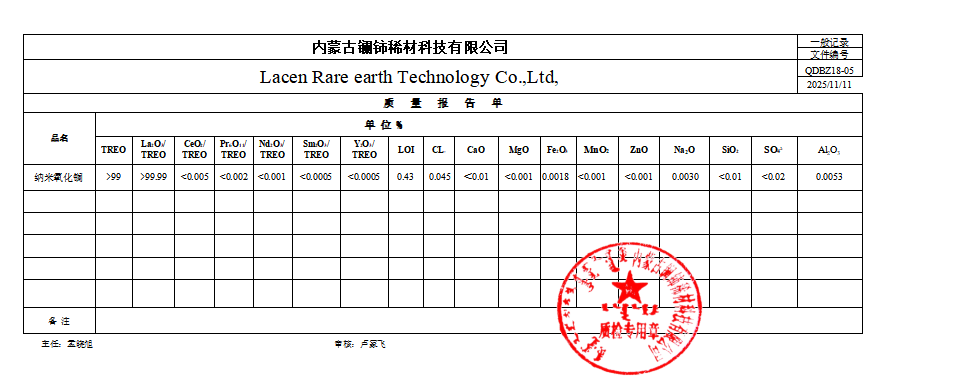
Procurement decisions directly impact project budgets and final film performance. There is a massive cost delta between standard commercial grades and highly purified ultrafine lanthanum oxide. High-purity materials (often rated at 99.99% or 4N purity) undergo rigorous chemical refinement to remove trace transition metals like iron, copper, or other rare earth elements like neodymium. These trace impurities cause unwanted light absorption, discoloration, or fluorescence under UV light.
You must establish a strict framework for deciding when high purity is necessary. Precision optics, laser lenses, and advanced display coatings require zero light absorption and demand the highest purity available. The steep procurement cost is easily justified by the optical performance and yield rates. Conversely, standard industrial anti-corrosion coatings, marine primers, or thermal barrier coatings do not require optical perfection. Standard commercial grades (99% to 99.9%) suffice for these applications, allowing for much more efficient budget allocation without sacrificing mechanical durability.
Formulation teams must choose between purchasing dry powders or pre-dispersed colloidal slurries. Each option carries distinct operational impacts, equipment requirements, and shelf-life limitations. Evaluating the true expenditure requires looking far beyond the initial invoice price per kilogram.
Purchasing dry powder requires significant in-house dispersion infrastructure. You need explosion-proof bead mills, ultrasonic processors, chiller units, and specialized engineering expertise to handle the surface modification. This carries a high processing risk, as a failed milling batch ruins both the nanomaterial and the base resin. Alternatively, buying pre-dispersed colloidal slurries shifts the processing risk to the supplier. The vendor handles the complex milling and stabilization phase, delivering a ready-to-drop-in liquid. However, slurries have a higher upfront cost and a strictly limited shelf life, often degrading within 3 to 6 months. They must be consumed before the suspension destabilizes and settles.
Handling nanoscale materials introduces severe environmental health and safety risks to the production floor. Documented EHS risks exist regarding airborne rare earth oxides. Inhalation of these dry nanoparticles leads to potential nephrotoxicity, pulmonary inflammation, and metabolic disruptions. Because the particles are smaller than 100 nanometers, they easily bypass natural respiratory filters. They can enter the bloodstream directly through the lungs and accumulate in internal organs over time.
Mandatory mitigation strategies are non-negotiable for any facility handling dry nano-powders. Facilities must implement closed-loop processing systems for powder transfer. Localized exhaust ventilation (LEV) must capture dust directly at the bag-dump station or mixing vessel. Strict personal protective equipment (PPE) compliance is required during the powder handling phase. Operators must wear highly rated particulate respirators (N100 or FFP3), sealed safety goggles, and disposable nitrile gloves to prevent dermal and inhalation exposure.
The raw material is highly sensitive to environmental conditions. It is strongly hygroscopic, meaning it readily absorbs moisture from the ambient air. Upon exposure to humidity, the oxide undergoes a rapid chemical reaction to form lanthanum hydroxide. This chemical shift alters its surface chemistry, changes its refractive index, and completely ruins its dispersion readiness. It makes the powder impossible to stabilize with standard silanes, rendering it unusable for high-end optical coatings.
You must enforce strict storage requirements in the warehouse. The powder must remain in its original vacuum-sealed packaging until the exact moment of use. Once a bag is opened, operators must store any remaining material in heavily desiccated environments (below 20% relative humidity) or under inert argon or nitrogen gas blankets. Proper inventory management and strict first-in, first-out (FIFO) protocols prevent expensive material degradation.
Audit your facility's current high-shear mixing and bead milling equipment to ensure it can achieve and maintain temperatures below 40°C during nanoscale reduction.
Request comprehensive assay reports and particle size distribution (DLS) data from your nanomaterial vendors before approving any raw material for optical formulation.
Initiate pilot formulations using varying ratios of silane coupling agents to identify the exact steric hindrance required for your specific solvent or aqueous resin matrix.
Establish strict environmental controls, including localized exhaust ventilation and N100 respirator mandates, before introducing dry nanoscale rare earth powders to the production floor.
A: The optimal particle size must remain strictly below 50 to 100 nanometers. Keeping the primary particles significantly smaller than the wavelength of visible light prevents Rayleigh scattering. This size threshold maintains high transparency, eliminates haze, and minimizes optical dispersion in the final cured film.
A: Poor dispersion causes nanoparticles to clump together into micro-clusters. These agglomerates act as severe defect centers within the resin matrix. They create localized stress concentrations, which initiate micro-cracking, reduce cross-linking density, and ultimately result in premature coating failure under mechanical impact or thermal stress.
A: Yes, it functions well in water-borne systems, but it requires specific hydrophilic surface modifications. Without appropriate water-soluble coupling agents or polymeric surfactants, the high-energy powder will rapidly agglomerate, form a hard cake, and settle out of the aqueous environment.
A: Handling the dry powder presents severe inhalation risks. Airborne nanoparticles easily bypass natural respiratory defenses, leading to potential bioaccumulation in organs, metabolic disruptions, and nephrotoxicity. Strict engineering controls, localized ventilation, and specialized N100 respirators are mandatory to prevent operator exposure.
A: Dispersion stability requires specialized analytical equipment. Zeta potential analysis determines the electrostatic repulsion between particles, with values over +/- 30mV indicating stability. Dynamic Light Scattering (DLS) verifies the exact nanoscale size distribution, while rotational viscometers monitor rheological changes to identify slow re-agglomeration.
A: The material possesses a very high melting point and exceptional thermodynamic stability. When uniformly dispersed, it increases the overall cross-linking density of the coating and bridges microscopic fissures. This structural reinforcement stabilizes the composite matrix, preventing the film from cracking or delaminating during rapid temperature changes.


