


Views: 0 Author: Site Editor Publish Time: 2026-07-15 Origin: Site


Formulating advanced industrial materials requires absolute molecular precision. Engineers and metallurgists know a single sourcing error easily cascades into massive production delays. Integrating raw materials for high-temperature refractory alloys, fluid catalytic cracking, or semiconductor manufacturing demands strict input controls. Selecting the wrong chemical grade or mishandling highly reactive powders inevitably leads to costly batch failures, compromised end products, and missed delivery schedules.
We designed this comprehensive guide to provide a robust, decision-stage framework for technical procurement teams and process engineers. You will discover how to evaluate, source, and deploy these critical rare earth compounds based on precise purity requirements and application-specific performance metrics. Properly sourcing and integrating Lanthanum Oxide ensures your production lines maintain peak operational efficiency while consistently delivering uncompromising quality.
Core Utility: Lanthanum oxide is primarily leveraged for its high dielectric constant (High-K), thermal stability, and basicity in catalytic reactions.
Procurement Drivers: Selection hinges on Total Rare Earth Oxide (TREO) purity (ranging from 99% to 99.999%), particle size distribution (D50), and trace impurity limits.
Implementation Risk: The material is highly hygroscopic; improper storage leads to moisture absorption (forming lanthanum hydroxide), altering weight, dosing calculations, and material performance.
Industries do not specify rare earth materials lightly. Sourcing managers and chemical engineers demand clear performance benefits before accepting higher raw material costs. You must justify the cost premium of Lanthanum Oxide over more abundant transition metal oxides through its unique chemical and physical properties. We evaluate this material across three primary performance dimensions.
First, thermal and structural stability set this compound apart in extreme environments. The material boasts a melting point of approximately 2,315°C. Such extreme heat resistance prevents structural degradation during intense manufacturing cycles. When dispersed into metal matrices, these oxide particles pin grain boundaries effectively. This pinning action restricts grain growth during thermal cycling, fundamentally enhancing the lifespan of high-temperature furnace components.
Second, dielectric performance drives massive adoption in modern microelectronics. Device miniaturization pushes traditional silicon dioxide to its absolute physical limits. When standard insulating layers become too thin, electrons tunnel through them, causing severe leakage currents. High-K materials solve this fundamental physics problem. They maintain equivalent electrical capacitance while allowing physically thicker insulating layers. This specific oxide offers exceptional High-K properties, making it indispensable for scaling CMOS technology.
Third, catalytic basicity transforms petrochemical processing. The compound features strongly basic surface sites. These basic sites improve reaction selectivity during harsh refining operations. They effectively suppress unwanted side reactions, such as coking, thereby extending catalyst lifespans and improving overall yield.
The following chart illustrates how this specific rare earth oxide compares against standard industrial alternatives across core engineering metrics.
Property Dimension | Standard Metal Oxides | Rare Earth Oxide Performance | Primary Industrial Benefit |
|---|---|---|---|
Thermal Stability | Degrades or melts below 1,600°C | Maintains integrity up to 2,315°C | Prevents sagging in refractory metal components |
Dielectric Constant (K) | Low (e.g., SiO2 ~ 3.9) | High (typically ~ 27) | Reduces quantum tunneling in semiconductors |
Surface Basicity | Neutral to acidic | Highly basic | Reduces coking and improves catalyst selectivity |
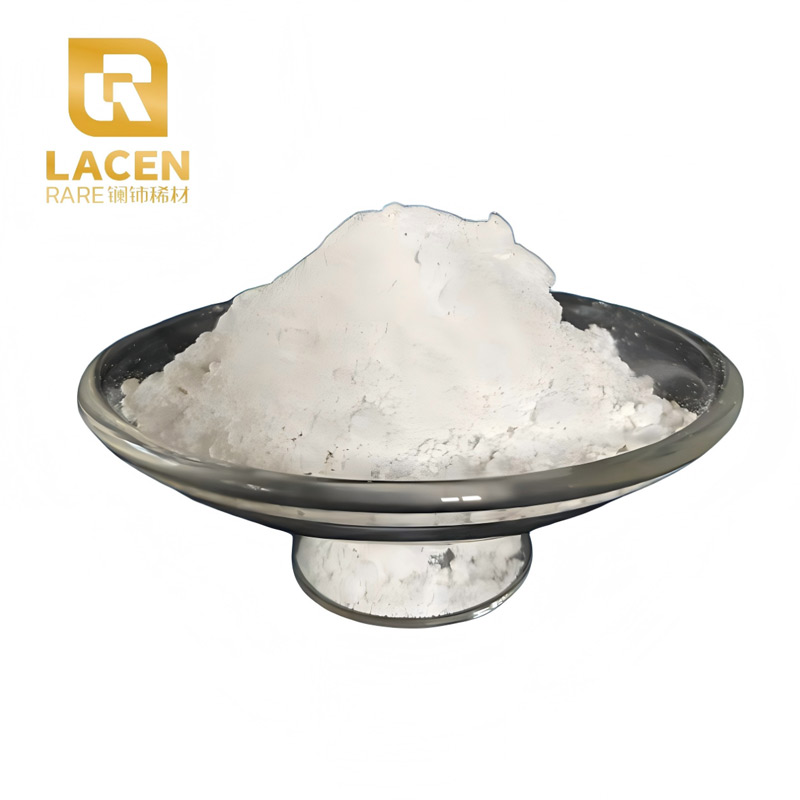
Mapping raw material properties directly to specific industry solutions clarifies exactly how chemical specifications influence expected success criteria. Different sectors deploy the material to achieve vastly different operational outcomes.
Refineries continuously process heavy crude fractions using Fluid Catalytic Cracking (FCC) units. Standard zeolites within these units degrade rapidly under intense steam and high-temperature regeneration cycles. Doping these catalysts stabilizes the ultra-stable Y (USY) zeolite framework. This stabilization prevents structural collapse during operation. As a direct outcome, refineries achieve increased gasoline yields. Furthermore, automotive manufacturers deploy the material within catalytic converters. The strong basic sites stabilize emissions control systems at elevated operating temperatures, ensuring prolonged regulatory compliance.
Semiconductor foundries push the physical limits of Moore's Law using advanced CMOS technology. Gate dielectrics require flawless insulating properties to function correctly. Traditional silicon dioxide layers leak excessive current at nanoscale dimensions. Foundries substitute these traditional oxides to create High-K gate dielectrics. This transition significantly reduces leakage current in miniaturized semiconductor devices while maintaining necessary electrical capacitance. The resulting microprocessors run faster, consume less power, and generate less waste heat.
Aerospace and thermal processing industries demand structural integrity at extreme temperatures. Pure molybdenum sags and deforms predictably when subjected to intense heat. Metallurgists solve this by creating Molybdenum-Lanthanum (Mo-La) alloys. They disperse fine rare earth oxide particles throughout the molybdenum matrix. This dispersion significantly increases the recrystallization temperature. The outcome drastically improves creep resistance compared to pure molybdenum, making these alloys perfect for high-temperature furnace components, sintering boats, and critical aerospace engine parts.
High-end optical engineering requires precise control over light manipulation. Camera lens manufacturers and precision optics designers formulate specialized optical glass batches. Incorporating the oxide into the glass matrix fundamentally alters its optical properties. The addition sharply increases the refractive index while simultaneously decreasing optical dispersion. Photographers and scientists directly benefit from sharper images, reduced chromatic aberration, and lighter lens assemblies. Electronic component manufacturers also utilize these tailored properties to produce highly specialized ceramic capacitors.
Buying highly specialized chemicals requires a rigorous evaluation framework. Procurement teams must confidently match vendor specifications to their exact operational use case. Specifying overly pure materials wastes budget, while under-specifying purity guarantees batch failures.
First, teams must navigate purity grades effectively. Vendors typically quote Total Rare Earth Oxide (TREO) alongside specific component purities. Commercial grades ranging from 99% to 99.9% provide sufficient performance for standard optical glass manufacturing or basic ceramics. However, microelectronics require high-purity or electronic grades ranging from 99.99% to 99.999%. At this level, parts-per-million variations fundamentally alter semiconductor yields. Purchasing managers must clearly understand when 99% meets operational needs and when 99.999% remains non-negotiable.
Second, particle morphology and surface area heavily dictate performance. Chemists measure specific surface area using the BET method. They measure particle size distribution via D50 metrics. High BET surface areas drastically improve catalytic efficiency by exposing more active sites to reacting gases. Conversely, precise D50 distributions ensure predictable packing density during powder metallurgy processes. Unpredictable morphology leads to uneven sintering and structural weak points in final components.
Third, trace impurity ceilings require strict enforcement. You must define the maximum allowable limits for competing rare earth elements and common contaminants. Trace amounts of Cerium or Neodymium will aggressively shift the dielectric profile of a semiconductor batch. Similarly, non-rare earths like Iron or Calcium destroy optical clarity in high-end lenses. You should draft internal specification sheets detailing exact limits for these elements.
Evaluate your raw material choices using this structured approach:
Determine the absolute minimum TREO percentage your process tolerates.
Define strict upper limits for problematic trace elements (Iron, Calcium, Cerium).
Specify optimal particle size distributions for your mixing or sintering equipment.
Demand transparent documentation proving batch-to-batch consistency.
Translating theoretical chemistry into factory floor reality presents significant operational challenges. Handling rare earth powders demands deep implementation expertise to prevent massive yield losses.
The most severe implementation risk involves managing the material's highly hygroscopic nature. Upon exposure to ambient atmosphere, the powder rapidly absorbs atmospheric moisture and carbon dioxide. This exposure triggers an immediate chemical conversion from the base oxide into lanthanum hydroxide. You cannot stop this reaction once atmospheric exposure occurs. It progresses aggressively, fundamentally altering the physical and chemical state of your inventory.
This rapid moisture uptake destroys production accuracy. The conversion to hydroxide significantly increases the physical mass of the powder. This weight increase causes dangerous miscalculations in stoichiometric weighing during manufacturing. If your process requires exactly ten kilograms of active oxide, but the powder has absorbed moisture, you will inadvertently dose far less active metal than your formula demands. This "bloating" effect ruins catalytic ratios, compromises glass clarity, and weakens metallurgical alloys.
Mitigating these risks requires unyielding storage protocols. You must implement mandatory requirements across your entire supply chain and staging areas. Best practices include:
Storing all unmixed inventory inside climate-controlled warehouse environments.
Demanding vacuum-sealed or argon-purged packaging from your suppliers.
Opening moisture-barrier bags only immediately prior to batch mixing.
Utilizing dry rooms or glove boxes when handling electronic-grade powders.
Process engineers frequently make the mistake of trusting partially resealed bags. Once an operator breaches the original vendor seal, the clock starts. You must either consume the remaining powder quickly or actively bake out absorbed moisture using controlled thermal treatments before subsequent use. However, thermal baking consumes energy, wastes production time, and introduces potential contamination vectors.
Finalizing your procurement strategy requires rigorously vetting potential suppliers. The chemical market features numerous brokers claiming high purity, but genuine technical competence separates reliable manufacturing partners from simple distributors.
You should primarily look for suppliers who provide verifiable Batch Certificates of Analysis (CoA) with every shipment. A generic CoA holds zero value. A technically sound CoA specifically details comprehensive trace impurity profiles, confirming exact parts-per-million levels of Iron, Calcium, and competing rare earths. If a vendor refuses to provide lot-specific analysis, you must disqualify them immediately.
Packaging capabilities serve as a critical indicator of vendor competence. Given the intense hygroscopic risks discussed previously, substandard packaging guarantees degraded material upon arrival. Evaluate their standard shipping protocols. Competent vendors utilize dual-sealed moisture-barrier bags, often backfilled with inert argon gas, packed securely inside rigid drums. A supplier shipping these reactive powders in simple plastic liners fundamentally misunderstands the material science.
Finally, assess supply chain resilience. The global mining and refining infrastructure for these materials remains geographically concentrated. This concentration presents significant logistics risks during geopolitical or trade disruptions. You must secure secondary supply lines. Ask vendors about their raw material origin, their domestic refining capabilities, and their standard buffer inventory levels. Resilient procurement teams build robust contingency plans to ensure uninterrupted access to these critical compounds.
Successfully deploying advanced rare earth materials requires balancing strict purity requirements against available operational budgets while meticulously managing handling risks. You cannot treat these highly reactive powders like bulk commodities. Precision in procurement directly drives predictability in manufacturing.
Your technical teams must prioritize rigorous vendor vetting and uncompromising storage protocols to prevent stoichiometric drift caused by moisture absorption. To move forward, we recommend requesting sample batches from shortlisted vendors for immediate morphology testing. Cross-reference their supplied Certificates of Analysis against your most stringent internal specification sheets to guarantee long-term production stability.
A: Shelf life depends entirely on the integrity of the moisture barrier packaging. When stored in intact, vacuum-sealed, or argon-purged bags within a climate-controlled environment, it remains stable indefinitely. Once exposed to ambient air, it rapidly absorbs moisture and carbon dioxide, significantly degrading its active chemical properties within a matter of hours.
A: Pure molybdenum readily sags and deforms under extreme heat. Doping the metal creates a molybdenum-lanthanum (Mo-La) alloy. The dispersed rare earth particles establish a microscopic grain-locking mechanism. This engineered microstructure significantly increases the recrystallization temperature and provides superior creep resistance, allowing components to maintain rigid structural integrity inside high-temperature furnaces.
A: Precursors are evaluated based on your final manufacturing process. While chlorides or carbonates dissolve easily for wet-chemical synthesis, the oxide form remains the industry standard for solid-state reactions. Substituting precursors requires drastically recalibrating reaction temperatures and off-gas management systems, as carbonates release carbon dioxide and chlorides release highly corrosive chlorine gas.


