


Views: 0 Author: Site Editor Publish Time: 2026-09-16 Origin: Site


Did you know light fades as it travels through glass? Imagine a flashlight beam stretching across the ocean. Eventually, the water absorbs the light. Internet signals traveling through transcontinental cables face a similar fate. Without intervention, these light pulses would simply die out over long distances.
Early telecommunication networks relied on slow and costly electrical conversions to fix this attenuation. Engineers had to intercept the weak light, convert it into electricity, boost the signal, and fire it back through a laser. Today, a highly specialized materials science breakthrough has rendered that clunky process completely obsolete.
In this comprehensive engineering guide, we will explore how integrating specific rare earth compounds into the glass matrix permanently solves signal loss. This chemical integration turns the passive fiber itself into an active optical amplifier.
Erbium Oxide is a specialized rare earth compound. It is utilized primarily to manufacture Erbium-Doped Fiber Amplifiers, which directly boost optical signals in global communication networks.
The most prevalent industrial technique for incorporating this dopant into silica glass is the Solution Doping Method. This operates in conjunction with Modified Chemical Vapor Deposition.
To prevent severe signal attenuation, fiber manufacturers are required to use telecom-grade materials. These typically range from 99.99% to 99.999% pure.
Co-doping the silica matrix with structural buffers like aluminum is a mandatory step. It prevents active ions from clustering and degrading amplification efficiency.
Beyond traditional telecommunications, this material is critical in developing medical surgical lasers, eye-safe LiDAR systems, and advanced fiber optic sensors.
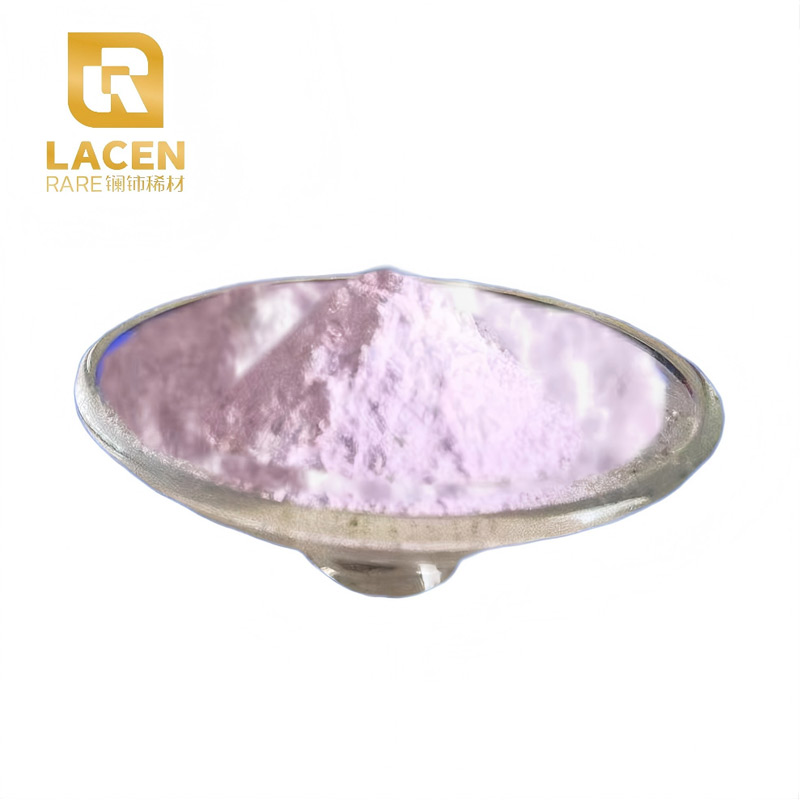
Erbium Oxide is a solid, slightly pink-tinted inorganic compound belonging to the rare earth metal oxide family. In the realms of materials science and photonics, it is celebrated for its highly unique electron configuration. When these specific atoms are incorporated into a solid glass matrix and excited by an external energy source, they exhibit incredibly stable optical behaviors.
The fundamental physics of optical amplification relies entirely on these active ions. An external pump laser, typically operating at 980 nanometers or 1480 nanometers, shines into the doped fiber. The ions absorb the photon energy and jump to a higher excited state. As the incoming weak internet signal passes through, it stimulates these excited ions to drop back to their ground state. During this descent, the ions release their stored energy as fresh photons.
Crucially, these newly generated photons are emitted at exactly the 1550-nanometer wavelength. In fiber optics, the 1550 nm mark is known as the C-band. This is the exact wavelength where standard silica glass exhibits the absolute lowest level of signal loss. By introducing erbium oxide for optical fiber cores, engineers effectively created an optical megaphone. The signal is boosted purely as light. This bypasses the need for electrical conversion and enables the high-bandwidth modern internet.
Industry Trend Insight: The explosive growth of AI-driven hyperscale data centers and global 5G networks is currently pushing the physical limits of existing silica fibers. Industry analysts note a massive shift toward multi-core fibers and expanded C+L band amplifiers to handle the incoming data tsunami. Submarine cable operators are desperate to maximize bandwidth without laying new physical lines. Consequently, engineering the exact concentration and dispersion profile of erbium within next-generation glass matrices is more critical today than ever before.
Fusing a rare earth metal into a rigid silica glass matrix is no small feat. It presents a complex metallurgical and chemical challenge. The dopant must be distributed evenly within the microscopic core of the fiber. Structural integrity cannot be compromised. The absolute transparency of the glass must be maintained. Manufacturers rely on several highly controlled doping methods to achieve this delicate balance on the factory floor.
The Solution Doping Method remains the most widely adopted process in commercial fiber optic manufacturing. It offers unmatched reliability and scalability. This procedure is typically performed alongside Modified Chemical Vapor Deposition.
Picture a hollow, ultra-pure quartz tube spinning steadily on a glassmaker lathe. Reactant gases like silicon tetrachloride are pumped into the tube. An external burner heats the exterior to approximately 1600 degrees Celsius. The gases react with oxygen to form a fine white powder called silica soot. This soot coats the inner wall of the tube, creating a highly porous, sponge-like layer of unsintered glass.
Subsequently, the tube is removed from the lathe and physically filled with a liquid solution. This liquid is formulated by dissolving the rare earth powder into hydrochloric or nitric acid. The porous silica soot acts exactly like a sponge and soaks up the erbium-rich liquid. After a specific soaking period, the liquid is drained. The tube is then dried using chlorine gas to strip away residual moisture. Finally, the burner temperature is cranked over 2000 degrees Celsius. This melts the porous soot into a solid, transparent layer of glass, permanently trapping the active ions inside.
While solution doping is highly effective, it involves liquid handling. This can inadvertently introduce moisture impurities into the core. To bypass this risk, Vapor Phase Doping eliminates liquids entirely. It delivers the dopant in a gaseous state during the initial deposition process.
Standard oxide powders do not vaporize easily at low temperatures. Therefore, manufacturers must use highly volatile precursors like organic erbium chelates. These compounds are heated in a specialized chamber until they vaporize. They are then mixed directly with the silicon gases. As the mixture passes through the burner heat zone, the erbium oxidizes and deposits directly into the glass soot. This method offers exceptional concentration control and significantly reduces the risk of hydroxyl contamination.
As modern networks demand higher amplification efficiencies, researchers have pioneered cutting-edge nanoparticle doping techniques. Instead of dissolving the material into a liquid or gas, manufacturers synthesize distinct nanoscale particles of the oxide. These nanoparticles are often coated with a protective shell of silica before being embedded into the glass. This physical encapsulation ensures that the active ions remain isolated from one another. It allows engineers to achieve much higher doping concentrations without degrading the signal.
Introducing the dopant is merely the foundational step. Materials scientists immediately face a significant chemical hurdle known as ion clustering. Understanding and mitigating this phenomenon is an absolute necessity for manufacturing telecom-grade optical amplifiers.
Pure silica glass possesses a highly rigid and tightly woven atomic network. Erbium ions have a relatively large ionic radius. They demonstrate extremely low solubility within this pristine matrix. When the raw material is introduced into the glass without any modifying agents, the ions cannot disperse evenly. Instead, they tend to aggregate and clump together in localized microscopic clusters.
This clustering leads to a severe optical failure known as concentration quenching. When ions are forced into close physical proximity, they begin to interact with one another rather than with the incoming optical signal. If one ion becomes excited by a pump laser, it may transfer its energy to a neighboring unexcited ion through a process called cooperative upconversion. Instead of emitting a photon at the desired 1550 nm wavelength to amplify the data signal, the energy dissipates as non-radiative heat. The optical fiber ends up absorbing light rather than amplifying it.
To resolve this fatal flaw, manufacturers employ a technique called co-doping. This involves introducing additional chemical elements into the glass matrix alongside the primary dopant. The most effective and widely used co-dopant in the industry is Aluminum Oxide.
Aluminum acts as a structural buffer. When added to the mix, it disrupts the rigid silica network and creates solvation shells around the individual erbium ions. By encapsulating them, the aluminum prevents the ions from migrating and bonding with one another during the high-temperature sintering phase. Empirical engineering data shows that aluminum co-doping eliminates concentration quenching. Furthermore, it broadens the emission spectrum, allowing the amplifier to boost a much wider range of optical channels simultaneously.
In the realm of advanced photonics, optical clarity is the absolute highest priority. The efficiency of a fiber is measured by its attenuation rate. This is the amount of signal lost over a specific distance, expressed in decibels per kilometer. To maintain the ultra-low attenuation required for transoceanic internet cables, utilizing anything less than telecom-grade high purity erbium oxide powder will result in catastrophic signal degradation.
The primary enemies of optical glass are transition metals and hydroxyl radicals. Even trace amounts of these impurities can absorb light in the near-infrared spectrum. They effectively destroy the data signal before it can be amplified.
Transition Metals: Elements such as Iron, Copper, Cobalt, and Nickel possess broad absorption bands that overlap directly with the 1550 nm transmission window. For instance, just 1 part per million of iron can induce an absorption loss of over 10 decibels per kilometer. This is entirely unacceptable for a medium where baseline losses are expected to be around 0.2 decibels per kilometer.
Hydroxyl Ions: Water contamination during manufacturing introduces hydroxyl radicals into the glass. These ions create a massive absorption spike known as the water peak at 1383 nm. If the concentration is too high, this absorption band broadens and interferes heavily with the C-band spectrum.
Because of these severe vulnerabilities, standard industrial-grade materials cannot be used. In the fiber optic industry, purity must be rigorously verified. 4N Purity at 99.99% is considered the absolute baseline for standard commercial applications. However, for high-performance submarine telecommunication cables, 5N Purity at 99.999% is mandatory. This restricts transition metals to strict single-digit parts per billion.
Purity Level | Er2O3 / TREO Ratio | Max Transition Metal Impurities | Typical Engineering Application |
|---|---|---|---|
3N (99.9%) | ≥ 99.9% | < 1000 ppm | Ceramics, basic glass tinting, metallurgical alloying |
4N (99.99%) | ≥ 99.99% | < 10 ppm | Short-range fiber optics, commercial solid-state lasers |
5N (99.999%) | ≥ 99.999% | < 1 ppm (Fe2O3 < 2ppm) | Long-haul telecom EDFAs, transoceanic submarine cables |
Beyond elemental purity, the physical characteristics of the powder dictate its actual viability on the production line. When utilizing the Solution Doping Method, the powder must dissolve completely and evenly in acid. Powders engineered with a highly uniform particle size distribution and a high specific surface area dissolve much more efficiently. Hard agglomerates lead to incomplete dissolution. This results in microscopic undissolved particles that cause severe Rayleigh scattering within the finished fiber core.
While global telecommunications remains the largest driver of demand, the unique luminescent properties of this material extend far beyond network amplifiers. The precise energy level transitions make it a highly sought-after rare earth oxide for optical glass across multiple advanced high-tech sectors.
Medical and Surgical Lasers: One of the most prominent alternative uses is in the medical sector. Engineers use doped glass to create Er:YAG solid-state lasers. These lasers operate at exactly 2940 nm. This specific wavelength aligns perfectly with the peak absorption spectrum of water. Since human tissue is primarily water, these lasers can precisely vaporize skin, bone, or dental enamel with microscopic accuracy. They generate almost no thermal damage to surrounding healthy tissues, making them the gold standard for drill-free dentistry.
LiDAR and Autonomous Vehicles: The autonomous vehicle industry relies heavily on LiDAR systems to map surroundings in real-time 3D. Many advanced systems utilize doped fiber lasers operating at 1550 nm. The primary reason is human safety. Unlike shorter wavelengths which can permanently damage the retina, 1550 nm light is safely absorbed by the cornea before reaching sensitive retinal tissue. Because it is eye-safe, engineers can operate these lasers at much higher power levels to see clearly through fog and heavy rain.
Fiber Optic Sensors: Doped fibers are increasingly utilized in extreme industrial environments as highly sensitive diagnostic tools. By embedding Fiber Bragg Gratings into the glass, engineers create distributed sensors capable of measuring minute changes in temperature, pressure, and structural strain. Completely immune to electromagnetic interference, they are safely deployed in deep-sea oil drilling rigs and critical aerospace components.
For engineers and procurement specialists in the photonics industry, selecting a raw material supplier is a critical operational decision. The extreme sensitivity of optical manufacturing means that a single batch of substandard material can result in hundreds of thousands of dollars in ruined production runs. You cannot afford batch inconsistencies or hidden impurities.
A reputable supplier must provide a comprehensive Certificate of Analysis for every individual batch. This document must detail exact Total Rare Earth Oxide purity levels and list the parts-per-billion concentrations of critical transition metals like Iron and Copper. Furthermore, ensure your supplier utilizes state-of-the-art analytical equipment such as Inductively Coupled Plasma Mass Spectrometry. Standard titration methods are simply insufficiently precise for telecom-grade requirements.
Top-tier suppliers understand that different doping techniques require tailored physical profiles. Facilities utilizing the Solution Doping Method require powders engineered for rapid acid dissolution. This means demanding high surface area and minimal agglomeration. Engaging with a supplier capable of customizing the physical morphology ensures a seamless integration into your proprietary manufacturing workflows.
If you are looking to upgrade your optical fiber production or develop next-generation photonic devices, securing a stable supply of ultra-pure raw materials is your first step. We highly recommend reviewing the rigorous specifications of premium materials to ensure your production lines run without interference. Explore specialized products like high-purity Erbium Oxide tailored specifically for fiber amplifier doping to guarantee your network components perform at their absolute peak.
High purity erbium oxide powder typically has a distinct, light pink color. This pink tint is a natural characteristic of the active ion and is often easily visible in heavily doped optical glass.
EDFA stands for Erbium-Doped Fiber Amplifier. It is a specialized device that uses a segment of optical fiber doped with erbium to amplify light signals directly, completely bypassing the need to convert them into electrical signals first.
Aluminum is used as a co-dopant to prevent active ions from clumping together in the silica glass. This structural buffering ensures even distribution, which is critical for efficient light amplification and preventing concentration quenching.
While it can be used to give glass a pink tint or to absorb infrared light, its primary and most valuable industrial use is as a rare earth dopant in precision lasers and telecommunication fiber optics.
Doping silica glass with rare earth elements slightly increases its refractive index. Engineers must carefully balance the concentration of dopants and co-dopants like germanium or aluminum to maintain the precise refractive index profile required for total internal reflection within the fiber core.
In commercial telecommunication amplifiers, the erbium concentration typically ranges from 100 to 1000 parts per million. Higher concentrations allow for shorter amplifier fiber lengths but significantly increase the risk of ion clustering and signal quenching.


