


Views: 0 Author: Site Editor Publish Time: 2026-08-31 Origin: Site


Aerospace engineers and medical imaging professionals expect flawless optical performance from modern lenses. The escalating demand for precision optics requires glass materials offering exceptional light-bending capabilities. Minimal color distortion is also absolutely critical for these advanced applications. Unfortunately, traditional additives face strict environmental phase-outs globally. Regulatory frameworks like RoHS force manufacturers to seek alternative compounds. You need dopants delivering high refractive indices without toxic environmental impacts.
We will explore how specific compounds solve these optical challenges. This guide provides engineers and procurement specialists a robust technical framework. You will learn to evaluate Lanthanum Oxide as the primary dopant for modern optical glass formulations. We detail everything from melting kinetics to sourcing strategies. By understanding the exact physical properties and supply chain dynamics, you avoid costly manufacturing defects. Let us dive into the science and strategy behind this vital material.
Optical Optimization: Lanthanum oxide significantly increases the refractive index while decreasing dispersion (high Abbe number), directly reducing chromatic aberration in multi-lens arrays.
Material Replacement: It serves as a superior, environmentally compliant alternative to lead-based glass additives.
Specification Matters: Yield rates heavily depend on the physical properties of the raw material, specifically utilizing fine grained lanthanum oxide to ensure homogeneous melting.
Sourcing Reliability: Evaluating suppliers requires assessing their entire rare earth oxide series for consistent purity, particle size distribution, and traceability.
Optical engineers constantly balance two competing properties in glass design. They need to bend light sharply. They also need to keep colors aligned. Lanthanum alters the fundamental physics of the glass matrix to achieve both goals.
Refractive index measures how much a material slows down light. Heavy atomic structures create denser optical matrices. Lanthanum is a dense rare earth element. When you introduce it into a silica or borate network, it drastically increases the overall matrix density. This allows lenses to bend light much more efficiently.
You can achieve the same focal length using less material. Designers leverage this property to manufacture thinner, lighter lens elements. This weight reduction proves critical in aerospace satellite cameras and portable medical endoscopes.
Bending light often causes a problem. Different wavelengths (colors) bend at different angles. This phenomenon separates white light into a rainbow. Engineers call this dispersion. It causes chromatic aberration, resulting in blurry or color-fringed images.
Lanthanum possesses unique electron configurations. It interacts uniquely across the visible spectrum. It prevents severe light separation. We measure this resistance to dispersion using the Abbe number. A higher Abbe number means lower dispersion. Lanthanum-doped glass maintains a remarkably high Abbe number. It corrects chromatic aberration natively within the glass.
Beyond manipulating light, this compound plays a vital structural role. The base glass network requires modifiers to stabilize it.
Network Integration: It acts as an intermediate glass former. It bridges gaps in the primary silica or borate network.
Mechanical Strength: The resulting bonds resist physical shock better than standard crown glasses.
Chemical Durability: It significantly improves resistance to atmospheric moisture and mild acids. This prevents lens clouding over long lifespans.
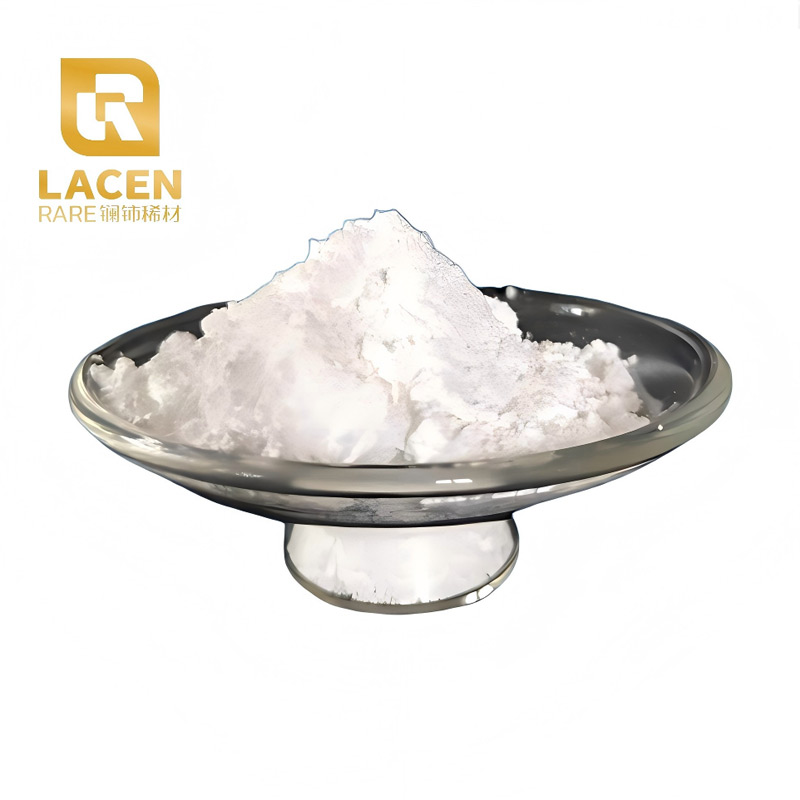
Procuring raw materials for precision optics leaves no room for error. A minor specification variance ruins an entire melting batch. You must rigorously evaluate your materials across several physical parameters.
Optical applications demand extreme purity. Industry standards typically require ≥99.99% (4N) purity. Some high-end applications push for 5N. Why is this necessary? Trace transition metals act as colorants.
Elements like Iron (Fe), Copper (Cu), and Chromium (Cr) readily absorb specific visible wavelengths. If iron enters the melt, it imparts a green tint. Copper introduces blue or brown hues. Even single-digit parts-per-million (ppm) levels degrade light transmittance. High purity ensures maximum light transmission and absolute color neutrality.
Purity alone does not guarantee a successful melt. Particle size distribution (PSD) dictates the melting kinetics. Coarse powders create significant manufacturing bottlenecks.
This is why leading facilities specify fine grained lanthanum oxide. Large particles dissolve slowly in the molten glass. They often leave behind un-melted "stones." These stones cause localized refractive index variations called striae. Striae distort the final image, rendering the lens useless.
Fine-grained variations offer a massive surface area. They dissolve rapidly and uniformly at lower temperatures. This homogeneous melting prevents optical defects. It ensures high transmission rates. Ultimately, it maximizes your acceptable batch yield.
We must also address environmental handling. This compound is highly hygroscopic. It aggressively absorbs moisture from the air. When it hydrates, it forms lanthanum hydroxide.
Introducing hydrated powders into a high-temperature furnace causes violent off-gassing. The trapped water vapor creates micro-bubbles within the glass matrix. Suppliers must employ strict calcination processes. You must ensure specialized, vacuum-sealed packaging prevents hydration prior to the melt.
The optical industry relied on alternative dopants for decades. Lead oxide (PbO) and barium oxide dominated early lens designs. However, modern constraints force a structural pivot away from these historical additives.
Global regulatory compliance drives this transition. Lead oxide is notoriously toxic. Frameworks like RoHS (Restriction of Hazardous Substances) and REACH heavily restrict its use. Manufacturing leaded glass exposes workers to toxic fumes. It also creates hazardous waste streams.
Lanthanum offers a safe, compliant path forward. It enables facilities to meet modern environmental standards. You protect worker health. You also future-proof your product lines against upcoming legislative bans.
Engineers map optical glass types on an Abbe diagram. This chart plots the refractive index against the Abbe number. Traditional lead glasses (flint glasses) achieve high refractive indices. Unfortunately, they suffer from terrible dispersion (low Abbe numbers).
Barium glasses improve dispersion. However, they cannot match the extreme refractive indices required for compact lens designs. Lanthanum creates a unique category: Lanthanum Crown and Lanthanum Flint glasses. These push into the top-left quadrant of the Abbe diagram. They deliver the high index of lead alongside the low dispersion of barium.
Optical Glass Dopant Comparison
Dopant Material | Refractive Index Impact | Abbe Number (Dispersion) | Environmental Status | Primary Glass Category |
|---|---|---|---|---|
Lead Oxide (PbO) | Very High | Low (High Dispersion) | Toxic / Restricted | Flint Glass |
Barium Oxide (BaO) | Moderate | High (Low Dispersion) | Safe | Barium Crown |
Lanthanum Oxide (La2O3) | Very High | High (Low Dispersion) | Safe / Compliant | Lanthanum Crown/Flint |
Procurement teams quickly notice a price difference. Premium lanthanum oxide products carry higher upfront raw material costs compared to lead. However, you must evaluate the broader operational offsets.
High-performance optics command premium end-product pricing in aerospace and photography markets. Furthermore, transitioning away from lead eliminates massive toxic waste handling fees. You drop specialized hazardous material transport costs. You reduce liability insurance premiums. The operational savings heavily offset the initial material investment.
Upgrading your glass formulation requires facility adjustments. You cannot simply drop this compound into a legacy furnace. It alters the chemical and thermal behavior of the melt entirely.
Lanthanum glass melts are incredibly aggressive. They exhibit strong corrosive properties at high temperatures. Traditional refractory materials, like fireclay or standard silica crucibles, cannot withstand this environment.
The melt will dissolve the crucible walls. This introduces massive aluminum and silica contamination into your pristine glass. Manufacturers must upgrade their infrastructure. You need platinum crucibles. Alternatively, you must use specialized platinum-lined or high-grade alumina refractory systems to prevent contamination.
Thermal processing windows become incredibly narrow. Introducing this compound significantly lowers the viscosity of the melt. It flows almost like water at peak temperatures. This low viscosity aids rapid mixing and homogenization.
However, it introduces a major risk during cooling. Low viscosity combined with heavy elemental structures increases the devitrification tendency. Devitrification means the glass attempts to crystallize as it cools. Crystals ruin optical transparency.
Adopting this technology requires rigorous process control. You must recalibrate thermal curves entirely. You need rapid quenching techniques to bypass the crystallization phase. Upgrading furnace linings and installing precise digital temperature controllers are mandatory steps. Operator training must focus heavily on respecting the narrow thermal processing windows.
Securing a steady, high-quality supply chain is your final hurdle. Rare earth markets operate differently than commodity chemicals. You must vet suppliers meticulously.
Always prioritize vertically integrated manufacturers. Many companies simply act as brokers. Brokers buy generic powders and re-label them. They cannot control the source chemistry.
True manufacturers control the complex separation and refinement processes. They extract the elements from raw ore. They execute the solvent extraction. Vertical integration guarantees traceability. If a defect occurs, a true manufacturer can trace it back to a specific extraction batch.
Optical production demands absolute consistency. A supplier might provide an excellent initial sample. Can they replicate it a year later? You need reliable Certificates of Analysis (CoA).
Cross-reference every CoA for exact particle size distributions. Verify the trace element limits rigorously. Even minor fluctuations in iron or moisture content will force your engineers to alter the melting recipe. Consistent materials keep production lines moving.
Look beyond a single product. Evaluate the supplier's entire rare earth oxide series. Advanced glass formulations frequently utilize multiple rare earths. You might need Yttrium for durability or Gadolinium for specific refractive tweaks.
Sourcing your entire series from one capable partner consolidates procurement. It builds a stronger vendor relationship. More importantly, it ensures geopolitical supply chain stability. Strong suppliers maintain robust domestic reserves and diversified global networks. They shield you from sudden export quotas or regional disruptions.
Lanthanum oxide is non-negotiable for manufacturing next-generation optical glass. It successfully balances optical perfection with strict environmental compliance. It delivers the high refractive index and low dispersion required for elite lenses while keeping facilities safe from toxic heavy metals.
To successfully integrate this material into your production lines, keep these actionable next steps in mind:
Align engineering and procurement teams closely on granulometry and chemical purity specs before requesting trial batches.
Audit your existing melting infrastructure. Upgrade to platinum-lined crucibles and precision thermal controllers to handle low-viscosity, corrosive melts.
Audit potential suppliers based on their vertical integration and ability to deliver a consistent, multi-element portfolio.
Do not leave your optical clarity to chance. Prompt your engineering team to request a technical data sheet (TDS) from a verified manufacturer today. Consult with a material engineer to match specific lanthanum grades precisely to your facility's melting infrastructure.
A: Finer particles offer a larger surface area. They dissolve much more uniformly into the silica matrix at lower temperatures. This rapid, complete dissolution prevents unmelted stones. It eliminates optical defects like striae. Ultimately, it reduces overall melting time and increases batch yield.
A: No. Lanthanum is a naturally occurring rare earth element. The stable isotope used in glass production (Lanthanum-139) is entirely non-radioactive. Historical lens designs sometimes used Thorium to achieve high refractive indices, which was radioactive. Lanthanum replaced Thorium precisely because it is safe and stable.
A: You must address its highly hygroscopic properties. It absorbs atmospheric moisture quickly. It must be stored in airtight, moisture-free, vacuum-sealed environments. If exposed to humidity, it converts to lanthanum hydroxide. Hydrated powders release water vapor during the melt, causing severe bubbling in the glass.
A: Transition metals represent the greatest threat. Iron (Fe2O3), Copper (CuO), and Chromium (Cr2O3) are heavily restricted. Even tiny parts-per-million (ppm) levels of these metals absorb visible light. They heavily degrade overall light transmittance and induce unwanted green, blue, or brown color shifts.


