


Views: 0 Author: Site Editor Publish Time: 2026-08-07 Origin: Site


The petrochemical industry relies heavily on maximizing Fluid Catalytic Cracking (FCC) yields. Today, facilities face increasingly harsh operational limits to extract every ounce of value. Pushing these units hotter and harder demands incredibly resilient materials. Standard zeolite catalysts degrade rapidly under extreme thermal and hydrothermal stress. Structural collapse leads to massive efficiency drops, necessitating rare-earth stabilization. Plant operators need a reliable way to maintain catalyst integrity without constant replacement.
Lanthanum Oxide ($La_2O_3$) has transitioned from a specialized additive to an indispensable baseline component for modern FCC catalysts. Its unmatched structural stabilization properties keep cracking operations profitable. We will break down technical evaluation criteria, implementation realities, and strategic sourcing requirements for integrating this critical material into commercial catalyst production.
Performance ROI: Doping ultrastable Y (USY) zeolites with Lanthanum Oxide directly correlates to extended catalyst lifecycle and higher gasoline yields.
Specification Precision: Evaluation must focus on targeted purity grades (typically 99% to 99.99%) and precise particle size distribution (PSD) tailored to specific reactor protocols.
Supply Chain Strategy: Successful procurement requires balancing high-purity demands against global rare-earth market volatility and lot-to-lot consistency risks.
Due Diligence: Vendor shortlisting must prioritize verifiable QA documentation, scalable delivery mechanisms, and robust environmental compliance handling.
Fluid Catalytic Cracking units operate under punishing conditions. Modern refineries push throughput limits continually. FCC reactors subject catalysts to extreme temperature swings. During the regeneration phase, temperatures frequently exceed 700°C. Heavy steam environments compound this thermal stress. This brutal combination triggers dealumination in unstabilized zeolite catalysts. Aluminum atoms literally strip away from the zeolite framework. The intricate cage structure subsequently collapses.
This structural collapse introduces severe cost implications. Rapid catalyst deactivation directly increases unit downtime. Facilities must purchase replacement catalysts at accelerated rates. Degraded catalysts also perform poorly during active cracking. They lose crucial active acid sites. Consequently, they fail to convert heavy gas oils into valuable gasoline fractions. Instead, they over-crack the feed. This elevated coke and dry gas production destroys profit margins. Refineries lose valuable liquid product yields.
To overcome this, manufacturers must establish strict success criteria. Achieving exceptional hydrothermal stability is paramount. A stabilized catalyst must extend operational life significantly. It must maintain high conversion rates across thousands of cycles. It must preserve selectivity under severe regeneration conditions. The industry requires an intervention step during catalyst manufacturing to lock the zeolite framework in place. Bare ultrastable Y (USY) zeolites simply cannot survive modern reactor demands alone. They require a dedicated chemical anchor to survive.
Zeolite stabilization relies on precise ionic exchanges. We introduce specific rare-earth elements during the manufacturing process. Lanthanum serves as the optimal candidate. During calcination, Lanthanum ions ($La^{3+}$) migrate deep into the sodalite cages of the Y-zeolite. They shed their hydration spheres under heat. These bare ions then position themselves strategically. They bond firmly across the framework oxygen atoms. This migration physically locks the aluminum atoms in place. It minimizes dealumination during high-temperature steam exposure.
We can clearly map this feature to a tangible outcome. The core feature is rare-earth ion exchange stabilization. The direct outcome is the preservation of Bronsted acid sites. Retaining these acid sites results in sustained, highly active cracking. Operators achieve deeper conversion of heavy feeds. Gasoline yields stabilize over the long term. Coke make decreases. This specific chemical anchoring makes Lanthanum Oxide exceptionally valuable for refineries.
You might wonder why engineers choose pure Lanthanum over other rare-earth blends. Competitive alternative analysis reveals stark differences. Mixed rare-earth carbonates are cheaper upfront. However, they contain varying levels of other elements. These inconsistencies reduce overall stabilization efficiency. Cerium-heavy blends present another problem. Cerium possesses strong redox properties. It changes oxidation states rapidly ($Ce^{3+}$ to $Ce^{4+}$). This behavior promotes unwanted dehydrogenation reactions in the FCC unit. Dehydrogenation creates excess coke and hydrogen gas. Specific Lanthanum applications outperform these alternatives because Lanthanum stays strictly in the $+3$ oxidation state. It provides pure structural support without triggering unwanted side reactions.
Catalyst Stabilizer Comparison
Stabilizer Type | Primary Function | Oxidation State Stability | Impact on FCC Yields |
|---|---|---|---|
Pure Lanthanum Oxide | Structural / Hydrothermal Stabilization | Highly Stable ($+3$ only) | Maximizes gasoline, minimizes dry gas. |
Cerium-Heavy Blends | Redox Reactions / Oxygen Transfer | Variable ($+3$ and $+4$) | Increases coke and hydrogen gas production. |
Mixed Rare-Earths | Basic Stabilization | Inconsistent | Variable yields due to lot inconsistencies. |
Scaling up catalyst production requires rigorous material evaluation. Purity requirements demand careful consideration. You must assess the cost-benefit ratio of standard versus high-purity grades. Standard grades range from 99% to 99.9% on a Total Rare Earth Oxide (TREO) basis. High-purity grades reach 99.999%. Over-speccing purity unnecessarily inflates raw material costs. Standard 99.9% grades typically provide maximum yield gains in baseline FCC applications. Pushing beyond this threshold rarely justifies the premium pricing.
Powder morphology and particle size distribution (PSD) are equally critical. You are dealing with solid-state chemistry or slurry-based doping. The powder morphology dictates how well the material disperses. Large, agglomerated clumps will not penetrate the zeolite matrix evenly. This leads to localized over-exchange and under-exchanged dead zones. You need a highly uniform PSD. Fine, consistent particles dissolve and exchange predictably during catalyst manufacturing.
Chart: Typical Particle Size Distribution Targets
Particle Metric | Acceptable Range (Microns) | Impact on Catalyst Integration |
|---|---|---|
$D_{10}$ | 0.5 - 1.5 | Ensures absence of ultra-fine dust hazards. |
$D_{50}$ | 3.0 - 5.0 | Optimal size for slurry dispersion. |
$D_{90}$ | 10.0 - 15.0 | Prevents agglomeration and settling issues. |
Trace impurity limits require extreme scrutiny. Even at 99.9% purity, the remaining 0.1% holds massive consequences. You must identify acceptable thresholds for competing rare earths and non-rare earth elements. Neodymium and Cerium are common co-elements. While small amounts are tolerable, large spikes alter performance. Non-rare earth elements act as direct catalyst poisons. Iron (Fe) is a severe threat. Iron promotes dehydrogenation, heavily increasing coke formation. Calcium (Ca) acts as a severe fluxing agent. It rapidly destroys the delicate zeolite lattice under heat. Setting ultra-low limits for Iron, Sodium, and Calcium is non-negotiable.
Integrating rare earths into continuous manufacturing introduces distinct process challenges. You must manage calcination temperatures meticulously. Heating the doped zeolite too quickly traps steam inside the micro-pores. This built-up pressure shatters the catalyst particles from the inside out. Dispersion protocols also demand tight controls. You must ensure uniform Lanthanum Oxide integration without severe agglomeration.
Consider these critical integration steps for successful production:
Slurry Preparation: Utilize high-shear mixers to break apart weak agglomerates before adding the zeolite powder.
pH Management: Maintain optimal acidic conditions to ensure full dissolution and maximum ion exchange efficiency.
Controlled Thermal Ramping: Implement multi-stage calcination heating profiles to safely vent steam and position the Lanthanum ions.
Environmental and handling compliance adds another layer of complexity. You must navigate the regulatory realities of storing and processing these materials. Lanthanum powders are highly hygroscopic. They actively absorb moisture from the surrounding air. They also react with atmospheric carbon dioxide to form carbonates. Facilities must utilize climate-controlled storage. Dust mitigation protocols remain mandatory. Processing dry powders requires specialized ventilation and filtration systems. Proper waste stream management ensures compliance with local heavy metal disposal regulations.
Finally, supply chain volatility presents a massive strategic risk. Global rare-earth element (REE) markets constrain output periodically. Geopolitical tensions frequently impact raw material availability. You cannot rely on spot-market purchases for critical catalyst components. Assess the necessity of diversified supply chains. Secure backup vendors across different geographic regions. Long-term volume agreements help insulate your production from sudden price spikes and material shortages.
Successful procurement goes far beyond securing a low per-ton price. Catalyst manufacturers must enforce stringent shortlisting logic. Lot-to-lot consistency ranks higher than theoretical maximum purity. A vendor might supply an exceptional 99.99% pure batch once. If their next batch drops to 98% or alters the particle size entirely, your production line halts. Baseline reproducibility guarantees stable FCC catalyst performance for the end-user.
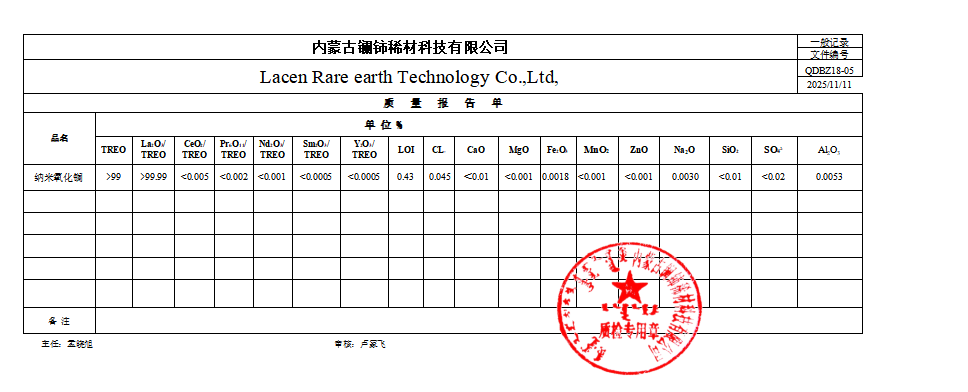
Vendor transparency serves as an absolute requirement. You must demand comprehensive Certificates of Analysis (COAs). These documents must match the exact physical shipments arriving at your dock. Do not accept generic marketing specifications. Insist on traceable, batch-specific testing data. Traceability ensures you can pinpoint issues rapidly if a catalyst batch fails quality control downstream.
Scalability assessment separates reliable partners from risky brokers. Evaluate a supplier's capacity to scale operations seamlessly. Transitioning from R&D bench scale (kilograms) to commercial continuous production (metric tons) stresses a vendor's quality control. Specification drift often occurs during this transition. A supplier must prove they own the necessary milling, refining, and packaging infrastructure.
When executing due diligence, prioritize these QA indicators:
In-house ICP-MS testing capabilities for verifying trace metal impurities.
Laser diffraction equipment for accurate batch-by-batch PSD reporting.
Climate-controlled packaging lines utilizing vacuum-sealed or moisture-barrier bags.
ISO 9001 and ISO 14001 certifications reflecting standardized operations.
Your next-step actions should focus on validation. Initiate pilot-scale testing protocols immediately. Request small samples to verify chemical integration. Once laboratory tests succeed, request a larger pilot volume. Audit the supplier's QA facilities directly. Verify their testing equipment matches their claimed capabilities. This hands-on validation secures your production stability.
Lanthanum Oxide is not a generic commodity. It is a highly specialized structural stabilizer that dictates the commercial viability of modern FCC catalysts. Its ability to lock the zeolite framework against severe thermal and hydrothermal degradation is unparalleled. Refineries depend heavily on this chemical mechanism to sustain gasoline yields and prevent costly unit downtime.
Shift your procurement focus away from simple price-per-ton metrics. Instead, optimize for total lifecycle value. Prioritize catalyst longevity, sustained yield improvement, and absolute supply stability. Partnering with transparent, scalable vendors ensures consistent manufacturing quality. Protect your formulations by demanding strict purity limits on trace heavy metals.
Contact a technical sales engineer today. Request detailed product specifications and advanced application notes. Secure a pilot-scale sample to begin internal validation for your next-generation FCC catalyst formulations.
A: Typically 99% to 99.9% (TREO basis), though specific trace element limits matter more than absolute purity depending on the reactor environment. Pushing for ultra-high purity grades often increases raw material costs without delivering measurable yield improvements in baseline refining operations.
A: Lanthanum is primarily used for structural/hydrothermal stabilization of zeolites, whereas Cerium is often leveraged for redox properties (oxygen storage/transfer) in emission control and specific cracking additives. Lanthanum effectively avoids unwanted dehydrogenation side reactions during the cracking process.
A: Variance in particle size distribution and trace heavy metal impurities, which can unexpectedly poison the catalyst or alter the calcination profile. Unreported iron or calcium spikes can instantly destroy zeolite lattice structures and increase coke generation significantly.
A: It is generally stable, but requires standard industrial dust control (hygroscopic nature means it absorbs moisture and $CO_2$ from the air) and compliance with local heavy/rare-earth metal disposal protocols. Storage facilities must utilize strict humidity management to prevent material agglomeration.


