


Views: 0 Author: Site Editor Publish Time: 2026-07-23 Origin: Site


High-precision optics demand materials pushing the boundaries of light refraction without introducing chromatic aberration. Standard glass formulations frequently struggle balancing intense bending power against aggressive color dispersion. For engineers and procurement teams specifying materials for advanced lenses and telecommunications, Lanthanum Oxide is a critical dopant and glass former. Incorporating this rare earth compound directly reshapes the fundamental structural network of a glass matrix. You achieve remarkable optical clarity and mechanical stability in highly demanding application environments.
This guide details the specific performance outcomes of integrating this material into optical glass and fiber. We outline essential purity requirements and strict trace metal limits necessary for quality assurance. Finally, you will uncover practical considerations for reliable procurement, moisture control, and precise implementation inside the melting furnace.
Optical Glass Core Benefit: La2O3 significantly increases the refractive index while maintaining a low dispersion rate (high Abbe number), enabling thinner, lighter, and more accurate lenses.
Optical Fiber Application: Doping silica fibers with La2O3 improves chemical durability, widens the transmission window, and mitigates signal degradation over long distances.
Purity is Non-Negotiable: Optical applications strictly require high-purity grades (typically 99.99% to 99.999% / 4N-5N) to prevent light absorption and scattering caused by transition metal impurities.
Handling Risks: Lanthanum Oxide is highly hygroscopic; precise storage and pre-processing moisture control are required to prevent structural defects in the final glass melt.
Modern microscopy, aerospace cameras, and premium consumer optics require lenses capable of extreme magnification and wide fields of view. Standard silicate glasses cannot achieve these high refractive indices. They typically introduce unacceptable color fringing, commonly known as dispersion. Optical engineers face severe physical limitations using traditional materials. They often stack multiple bulky lens elements together to correct visual distortion. This workaround adds unacceptable weight and manufacturing complexity to the final device assembly.
Adding Lanthanum Oxide solves this fundamental design challenge. Historically, manufacturers used heavy lead oxide to boost the refractive index. Global environmental regulations now strictly prohibit widespread lead usage in consumer applications. Modern glassmakers replace toxic lead compounds to ensure RoHS compliance. The rare earth dopant expertly alters the internal glass matrix to bend incoming light more efficiently. It creates a highly stable, environmentally safe atomic network.
This unique property combination allows optical engineers to design sophisticated multi-lens arrays using fewer individual elements. You can dramatically reduce the overall size and weight of a camera objective or scientific microscope piece. The modified material achieves impressive refractive indices (Nd). These values often exceed 1.7 to 1.8 in commercial applications.
Furthermore, the modified glass maintains impressively low dispersion. This directly addresses and corrects challenging chromatic aberration. High Abbe numbers indicate minimal color splitting across the visible light spectrum.
The following reference table illustrates the performance shift across common optical materials:
Glass Category | Typical Refractive Index (Nd) | Abbe Number (Vd) | Primary Application Focus |
|---|---|---|---|
Standard Crown | 1.50 - 1.54 | 55 - 65 | Basic windows, simple corrective lenses |
Dense Flint | 1.60 - 1.75 | 25 - 35 | Prisms, high-dispersion corrective elements |
Lanthanum Crown/Flint | 1.70 - 1.85+ | 40 - 50+ | Premium photographic lenses, aerospace optics |
Optical elements frequently operate in harsh physical environments demanding extreme material resilience. Incorporating rare earth oxides increases the underlying glass transition temperature (Tg). A higher Tg means the final product resists thermal shock and physical deformation under intense heat stress.
It also enhances resistance to severe chemical weathering. Excellent alkali and acid resistance prove crucial for exterior lenses operating outdoors. Aerospace sensors, medical endoscopes, and industrial laser cutting heads rely completely on this enhanced durability. They maintain perfect surface integrity over years of continuous deployment.
Telecommunications infrastructure and specialty fiber optics heavily depend on advanced rare earth doping. High-performance global networks require flawless data transmission across thousands of oceanic miles. Medical surgical scopes and high-power fiber lasers also require advanced structural characteristics to operate reliably. Unmodified silica fibers simply cannot handle these intense modern bandwidth demands.
Standard silica fibers exhibit natural physical limitations regarding specific light transmission bands. Doping the internal fiber core broadens the infrared transmission window significantly. This vital expansion allows multiple data channels to operate simultaneously on a single strand.
It also powerfully reduces overall optical attenuation, meaning much less signal loss occurs. You immediately improve data transmission rates over incredibly long distances. Lower natural attenuation directly translates to fewer required repeater stations along costly undersea telecom cables.
Modern internet backbone networks use Erbium-Doped Fiber Amplifiers (EDFAs) to seamlessly boost decaying light signals. Lanthanum Oxide acts as a highly effective co-dopant in these specialized amplification systems. It helps disperse active Erbium ions evenly within the microscopic fiber core.
This precise spatial dispersion prevents a critical failure known as "concentration quenching." When Erbium ions cluster together, they steal photon energy from each other rather than amplifying the actual data signal. Co-doping increases overall amplification efficiency. We can categorize the specific EDFA benefits here:
Increases the total solubility of rare-earth active ions in the silica matrix.
Creates uniform spatial separation between individual Erbium particles.
Maximizes photon emission stability during the critical amplification phase.
Reduces background noise introduced into the telecommunications signal stream.
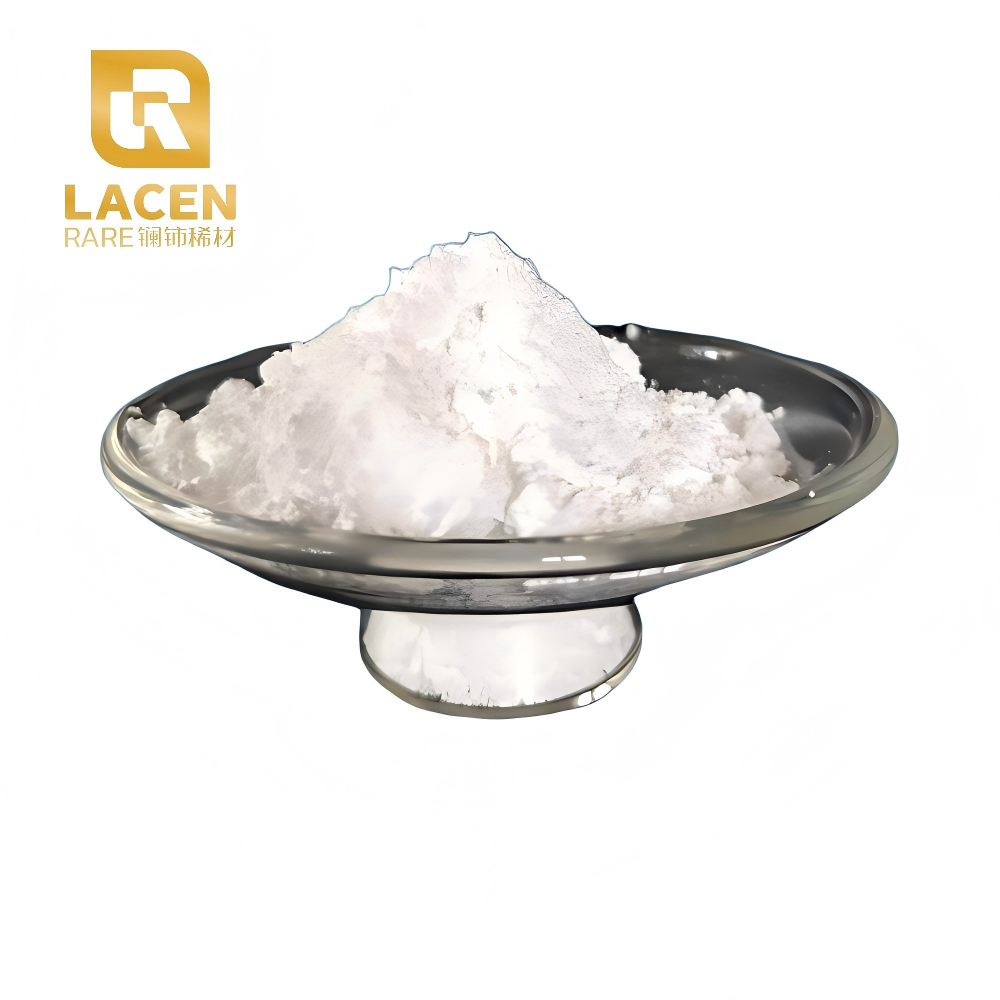
Not all raw materials remain viable for sensitive optical use. Procurement teams must align raw material specifications directly to required transmission outcomes. Purchasing standard industrial-grade powders will systematically destroy high-end glass melts. Evaluating true material purity requires strict adherence to advanced analytical chemistry metrics.
Optical glass manufacturing requires extreme purity validation. Standard acceptable grades span 99.99% (4N) to 99.999% (5N) purity. Strict tolerances dictate all acceptable contaminant levels. Transition metals and other adjacent rare earths must remain heavily restricted.
Contaminants like Cerium (Ce), Praseodymium (Pr), or Iron (Fe) must be strictly controlled. Manufacturers often cap these elements well below 1-5 parts per million (ppm). They cause unwanted light absorption and color tinting inside the final optic block.
The following chart illustrates typical evaluation parameters for 5N optical-grade materials:
Trace Impurity Element | Maximum Allowable Limit (ppm) | Negative Optical Consequence |
|---|---|---|
Iron (Fe) | < 2 ppm | Broadband light absorption, visible green tinting |
Cerium (Ce) | < 3 ppm | Aggressive UV absorption, severe solarization effects |
Praseodymium (Pr) | < 2 ppm | Visible spectrum color absorption lines |
Neodymium (Nd) | < 3 ppm | Undesirable infrared absorption bands |
Chemical purity only solves half the procurement equation. Physical characteristics heavily dictate melting success inside the actual furnace. The D50 particle size must be precisely optimized for homogeneous mixing. A tight particle size distribution guarantees even blending into the glass batch alongside raw silica and required fluxes.
Consistent surface area, measured by rigorous BET analysis, ensures highly predictable melting behavior. Proper morphology absolutely prevents unmelted inclusions from forming inside the glass matrix. These solid crystalline defects, known as stones, will permanently ruin the final lens block.
Operating a commercial glass furnace requires acknowledging the real-world friction of specialty raw materials. Addressing physical handling challenges immediately prevents massive financial losses. Theoretical chemistry must translate into predictable factory floor processes. Operators must trust their handling protocols explicitly to guarantee safety and yield.
Lanthanum Oxide absorbs atmospheric moisture rapidly from the surrounding air. This swift reaction forms Lanthanum Hydroxide [La(OH)3]. The consequence proves disastrous for ultimate glass clarity. Moisture trapped inside the melt causes violent chemical outgassing. This reaction leads directly to microscopic bubbles, called seed, scattered randomly throughout the optical glass.
Mitigation requires strict environmental control. We recommend several operational best practices to preserve material integrity:
Insist on multi-layered, vacuum-sealed packaging directly from the supplier.
Mandate strict climate-controlled storage facilities maintaining very low relative humidity.
Implement a pre-calcination thermal step to bake off residual moisture just before batching.
Minimize open-air exposure times during routine transferring and weighing procedures.
Refractory oxide integration forces profound structural changes to furnace management. The material requires significantly higher baseline processing temperatures. These extreme thermal loads drastically increase the corrosion rate of melting crucibles. Platinum and ceramic refractory liners degrade much faster under these punishing conditions.
Manufacturers must carefully balance the overall batch composition. Adding specific chemical fluxes like Boron or Barium helps manage the resulting melt viscosity. These strategic additions optimize the vital temperature profile. Finding the correct thermal balance prevents excessive crucible wear while ensuring complete powder dissolution. A common mistake involves raising temperatures too quickly. Rapid heating traps dangerous air bubbles before the fluxes can properly lower the structural viscosity.
Commercial-scale optical manufacturing demands rigorous supplier vetting. Evaluating potential vendors goes far beyond simple pricing matrices. You must assess their capacity to support highly technical production runs over long periods.
Batch-to-Batch Consistency serves as the primary driver of predictable optical yield. Complex optical formulas tolerate zero chemical variation. You must request detailed Certificates of Analysis (CoA) for every single shipment. These documents must demonstrate tight control over transition metal traces across multiple distinct lots. A truly reliable partner willingly shares historical analytical data to prove their consistent refinement capabilities.
Transporting sensitive hygroscopic powders requires robust protective barriers. Vendors must provide verifiable moisture-proof, highly durable packaging. We recommend specifying specialized mylar inner liners or hermetically sealed steel drums. Inferior packaging compromises the material specification during transit, especially during prolonged oceanic shipping.
Geopolitical concentration heavily impacts rare earth element availability. Sudden global market shifts can halt production lines overnight. Buyers should carefully assess the supplier's raw material sourcing transparency. Prioritize vendors demonstrating stable mineral access and reliable lead-time stability. A transparent supply chain ensures your manufacturing operations remain completely uninterrupted during sudden global market fluctuations.
Lanthanum Oxide remains an indispensable raw material for advanced photonics. It guarantees the high refractive index, low dispersion, and absolute signal clarity required in top-tier optical glass and fiber. Modern technologies simply cannot function efficiently without these specialized characteristics.
Your production success depends heavily on pristine material purity and uncompromising moisture control. Engineers and procurement teams should audit all potential suppliers immediately. Base these stringent audits strictly on historical trace metal analysis and rigorous packaging standards.
Contact our technical sales team to request a certified material sample. You can review a detailed CoA for our advanced optical-grade powders today. We stand ready to discuss custom particle size requirements tailored perfectly for your specific glass melt application.
A: Lanthanum Oxide achieves a similarly high refractive index but without the severe environmental and health hazards associated with heavy metal (lead) toxicity. It is the established standard for manufacturing RoHS-compliant precision optics globally.
A: Absorbed moisture introduces hydrogen/water molecules into the glass melt. This results in outgassing, creating micro-bubbles (seeds or blisters) that scatter light and completely ruin the optical clarity of the final lens or fiber.
A: Specialty optical fibers typically require 99.999% (5N) purity. Even trace parts-per-million (ppm) of impurities like iron or copper can cause severe optical attenuation (signal loss) over long transmission distances.
A: While other oxides (like Niobium or Tantalum) are used to adjust refractive properties, La2O3 offers a unique balance of high index and low dispersion (high Abbe number) that is highly difficult to replicate cost-effectively with alternative dopants.


