


Views: 0 Author: Site Editor Publish Time: 2026-08-15 Origin: Site


The escalating demand for precision optics constantly pushes modern manufacturing limits. Industries spanning aerospace, premium photography, and astronomical equipment require highly advanced glass formulations. These specialized materials must achieve exceptionally high refractive indices. Crucially, they must accomplish this without introducing severe chromatic aberration into the optical system.
Lanthanum Oxide (La2O3) serves as the critical rare-earth additive solving this complex challenge. It effectively resolves the traditional trade-off between light refraction and color dispersion. Using this specialized dopant, you can design significantly thinner, lighter lenses. These modern lenses possess exceptional light-bending properties previously considered impossible.
We tailored this technical guide specifically for procurement leads and optical engineers. It helps you navigate the daily complexities of industrial-scale glass manufacturing. You will learn how to evaluate exact purity standards and implement rigorous handling protocols. We also detail clear strategies for verifying long-term supplier reliability. Mastering these foundational elements ensures your optical products maintain a distinct competitive edge.
Optical Performance: Lanthanum Oxide drastically increases the refractive index while maintaining high Abbe numbers (low dispersion), essential for premium lenses.
Purity is Paramount: Trace rare-earth impurities (like Cerium or Neodymium) must be strictly controlled to prevent unwanted light absorption or color tinting.
Handling Realities: La2O3 is highly hygroscopic; precise environmental controls during storage and batching are required to prevent hydration and formulation errors.
Strategic Sourcing: Supplier evaluation must prioritize batch-to-batch consistency, verified certificates of analysis (CoA), and secure supply chains.
Legacy additives once dominated the optical glass industry. Manufacturers relied heavily on Lead Oxide to bend light effectively. However, these traditional materials fail modern environmental compliance standards. They also fall short of current elite optical demands. Heavy metals create highly toxic manufacturing environments. Furthermore, they add unnecessary physical weight to final camera and telescope products. This harsh reality makes modern rare-earth dopants absolutely necessary.
Integrating Lanthanum Oxide provides immediate, physics-level benefits. It allows manufacturers to create specialized "lanthanum crown" and "lanthanum flint" optical glasses. These specialized glasses exhibit a highly unique property profile. They drastically increase the refractive index while maintaining high Abbe numbers. A high Abbe number directly translates to low color dispersion. You avoid the typical color fringing seen in standard high-index glass. Consequently, engineers can design thinner lens elements. They still achieve superior, flawless light-bending capabilities.
These distinct material properties directly drive commercial success across various end-use applications.
Ultra-wide camera lenses: Professional photographers demand absolute edge-to-edge sharpness. Lanthanum-doped glass corrects severe optical distortion at the extreme edges of the camera frame.
Medical endoscopes: Surgeons need absolute visual precision. Miniaturized surgical lenses use these compounds to deliver crystal-clear, distortion-free imaging inside the human body.
Astronomical telescope eyepieces: Stargazing requires maximum possible light transmission. High-performance glass ensures minimal chromatic aberration during deep-space observation sessions.
Material purity directly dictates final optical performance. You must evaluate technical specifications carefully before finalizing any procurement decisions. We generally categorize purity thresholds from 99.9% (3N) up to 99.999% (5N). Specific purity levels correlate directly to distinct optical applications. Standard commercial lenses might easily tolerate 3N purity. However, advanced photonics and premium aerospace optics demand strictly 4N or 5N grades. Higher purity directly reduces unwanted light transmission loss across the optical spectrum.
Managing trace impurities remains a major manufacturing challenge. Transition metals and other rare earths pose significant coloration risks. Strict limits on iron (Fe) and copper (Cu) are absolutely non-negotiable. Even single parts-per-million (ppm) levels of these metals will tint colorless optical glass. Similarly, you must control other rare earths like Neodymium (Nd), Praseodymium (Pr), and Cerium (Ce). Neodymium introduces a distinct purple hue. Cerium causes strong ultraviolet light absorption. You cannot compromise on these strict limits if you manufacture pristine, transparent optical elements.
Beyond chemical purity, physical characteristics matter immensely. Particle size and morphology impact how the raw material behaves inside your furnace.
Specific Surface Area (BET): A higher BET indicates a significantly more reactive powder. It melts faster but can agglomerate quickly if improperly handled.
Particle Size Distribution (D50): Consistent D50 values ensure highly uniform melting rates. Narrow size distributions prevent unmelted inclusions from forming inside the glass melt.
Engineers must match these physical parameters to their specific crucible environments. Complete homogeneity in the glass melt relies entirely on a stable, predictable particle profile. Unplanned variations in morphology will disrupt your established manufacturing parameters.
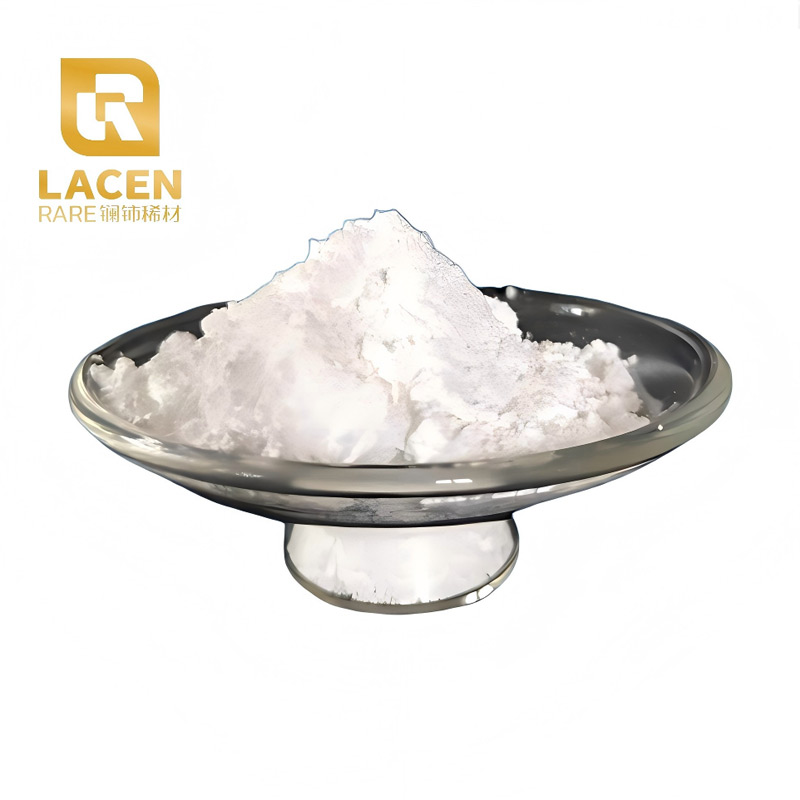
Optical engineers often weigh multiple additives during the initial formulation phase. Comparing Lanthanum Oxide against leading alternatives clarifies its highly unique advantages.
Niobium Oxide (Nb2O5) frequently appears in high-index glass discussions. Both oxides increase the refractive index quite effectively. However, they yield completely different optical outcomes. Lanthanum maintains a high Abbe number, ensuring low dispersion. Niobium tends to lower the Abbe number, causing higher dispersion. Additionally, Niobium restricts ultraviolet (UV) transmission much more than Lanthanum. Material costs also differ significantly, as Niobium generally commands a higher global market price. In many advanced formulations, engineers use them as strategic complements rather than strict substitutes. They carefully balance the refractive profile by blending both dopants.
When comparing against Lead (PbO) or Barium (BaO), regulatory compliance drives the conversation. The Restriction of Hazardous Substances (RoHS) directive heavily restricts lead usage globally. Replacing toxic heavy metals with safe lanthanides solves this compliance issue immediately. Furthermore, lanthanides offer significant physical weight advantages. Traditional lead glass is notoriously heavy. Lanthanum-doped glass provides identical or superior refractive capabilities at a fraction of the total weight.
We developed a clear decision framework for internal R&D teams. This matrix helps balance optical requirements, material costs, and overall manufacturing feasibility.
Additive Material | Refractive Index Impact | Dispersion (Abbe Number) | Environmental Compliance | Primary Use Case |
|---|---|---|---|---|
Lanthanum Oxide (La2O3) | High Increase | Maintains High (Low Dispersion) | Excellent (RoHS Compliant) | Premium camera lenses, telescopes |
Niobium Oxide (Nb2O5) | Very High Increase | Lowers (High Dispersion) | Excellent (RoHS Compliant) | Thin consumer eyewear, complementary doping |
Lead Oxide (PbO) | High Increase | Moderate | Poor (Heavily Restricted) | Legacy optics, radiation shielding |
Barium Oxide (BaO) | Moderate Increase | Maintains High | Acceptable (Toxicity concerns exist) | Standard commercial crown glass |
Transitioning to rare-earth dopants introduces highly specific manufacturing challenges. Lanthanum Oxide presents a notable hygroscopic challenge. It rapidly absorbs ambient atmospheric moisture upon exposure. This chemical reaction forms Lanthanum Hydroxide [La(OH)3].
This natural hydration process fundamentally alters the true weight of the active oxide. If your powder absorbs water, a 100-kilogram batch no longer contains 100 kilograms of pure La2O3. It contains a complex mixture of oxide, hydroxide, and trapped water. This causes severe stoichiometric imbalances in patented glass formulations. If you do not account for this hidden moisture prior to melting, the resulting glass will fail refractive index quality checks.
Mitigating this specific risk requires strict storage and facility requirements.
Demand industrial vacuum-sealed packaging directly from the raw material supplier.
Maintain climate-controlled warehousing equipped with active, continuous dehumidification.
Enforce immediate facility use post-opening to minimize dangerous atmospheric exposure.
Many advanced optical facilities pre-calcine the powder immediately before batching. Industrial calcination drives off all absorbed moisture. It guarantees you add the precise molecular weight required by the exact formulation.
Safety and MSDS compliance also demand immediate attention. While rare earths lack the severe toxicity of lead, they still pose inhalation risks. Standard industrial hygiene practices remain mandatory. Handlers must wear appropriate particulate respirators. Facilities should install localized exhaust ventilation near all batching stations. Managing fine powders properly protects worker health and completely prevents cross-contamination.
Securing a reliable supply chain ensures long-term manufacturing stability. Thorough supplier evaluation goes far beyond basic market pricing.
Batch-to-batch consistency always stands as the top procurement priority. Optical manufacturers require extensive historical data. You need stringent Quality Assurance (QA) records from your chosen supplier. Even minor fluctuations in purity or particle size cause severe refractive index drift between production runs. Refractive drift ruins entire batches of premium glass. Consistent suppliers eliminate this highly expensive manufacturing variable.
Traceability and supply chain security are equally vital. You should source from suppliers offering completely transparent extraction and refining pathways. Geopolitical shifts often impact rare-earth availability globally. A transparent supplier easily mitigates sudden market shortages. They provide absolute confidence in ethical and sustainable material mining practices.
Customization capabilities usually separate average vendors from true manufacturing partners. High-end glass manufacturers use highly specific crucible and furnace environments. Look for partners who can perfectly tailor particle size distributions. Some specialized suppliers even offer pre-calcined variants designed for immediate factory batching. This specific customization reduces your internal processing overhead significantly.
Take these concrete next-step actions when vetting new partners:
Request a highly detailed Certificate of Analysis (CoA) targeting trace rare-earth elements.
Order a controlled material sample for a dedicated pilot melting trial.
Conduct a virtual or physical audit of the supplier's internal packaging protocols.
Upgrading your optical formulations to include Lanthanum Oxide represents a vital strategic investment. It directly enhances product quality and significantly boosts market competitiveness for optical manufacturers. You successfully leave behind the severe limitations and regulatory burdens of legacy heavy metals.
However, successful industrial adoption requires strict internal discipline. It relies equally on securing maximum material purity and enforcing rigorous facility handling. Comprehensive moisture control and precise batching practices remain absolutely non-negotiable for success.
To move forward effectively, engage your procurement and engineering teams today. Consult with technical specialists regarding your specific glass formulation limits. Request comprehensive material data sheets (TDS/MSDS) from all prospective vendors. Initiate a formal sample qualification process immediately. Taking these proactive actions ensures your next generation of precision optics meets the highest possible industry standards.
A: Lanthanum Oxide replaces Lead Oxide primarily for strict environmental compliance. Regulatory frameworks like RoHS heavily restrict toxic lead usage. Beyond safety, lanthanide integration delivers superior optical physics. It drastically increases the refractive index while maintaining high Abbe numbers. This precise balance allows engineers to eliminate severe chromatic aberration. You can ultimately design thinner, lighter lens elements. Lead simply cannot match this specific combination of low weight, non-toxicity, and elite light-bending performance.
A: The powder remains highly hygroscopic. It rapidly absorbs ambient atmospheric moisture upon exposure. This natural chemical reaction converts the pure material into Lanthanum Hydroxide. Hydration fundamentally alters the physical weight of the powder batch. If you do not account for this added water weight, you will introduce severe stoichiometric imbalances into your formulation. These formulation inaccuracies ultimately cause the final glass melt to fail critical refractive index quality checks.
A: Standard commercial optical glass typically requires a baseline purity of 3N (99.9%). However, advanced photonics, premium photography lenses, and aerospace optics demand much higher thresholds. These sensitive applications require 4N (99.99%) or 5N (99.999%) purity grades. Higher purity levels directly reduce unwanted light transmission loss. They also strictly limit trace transition metals and other rare earths. This rigorous control prevents any accidental color tinting or unwanted ultraviolet absorption.
A: Yes, optical engineers frequently co-dope this material alongside other rare-earth elements. Formulations often combine it alongside Yttrium Oxide, Gadolinium Oxide, or Niobium Oxide. These complex blends allow manufacturers to make highly specialized refractive adjustments. Different dopants complement each other to fine-tune specific light wavelengths. This strategic combination approach helps R&D teams balance material costs, precise dispersion targets, and ultraviolet transmission requirements for specialized industrial optics.


